

Knowledge base · Service-King
RFID UHF and NFC: differences and selection of the reading method
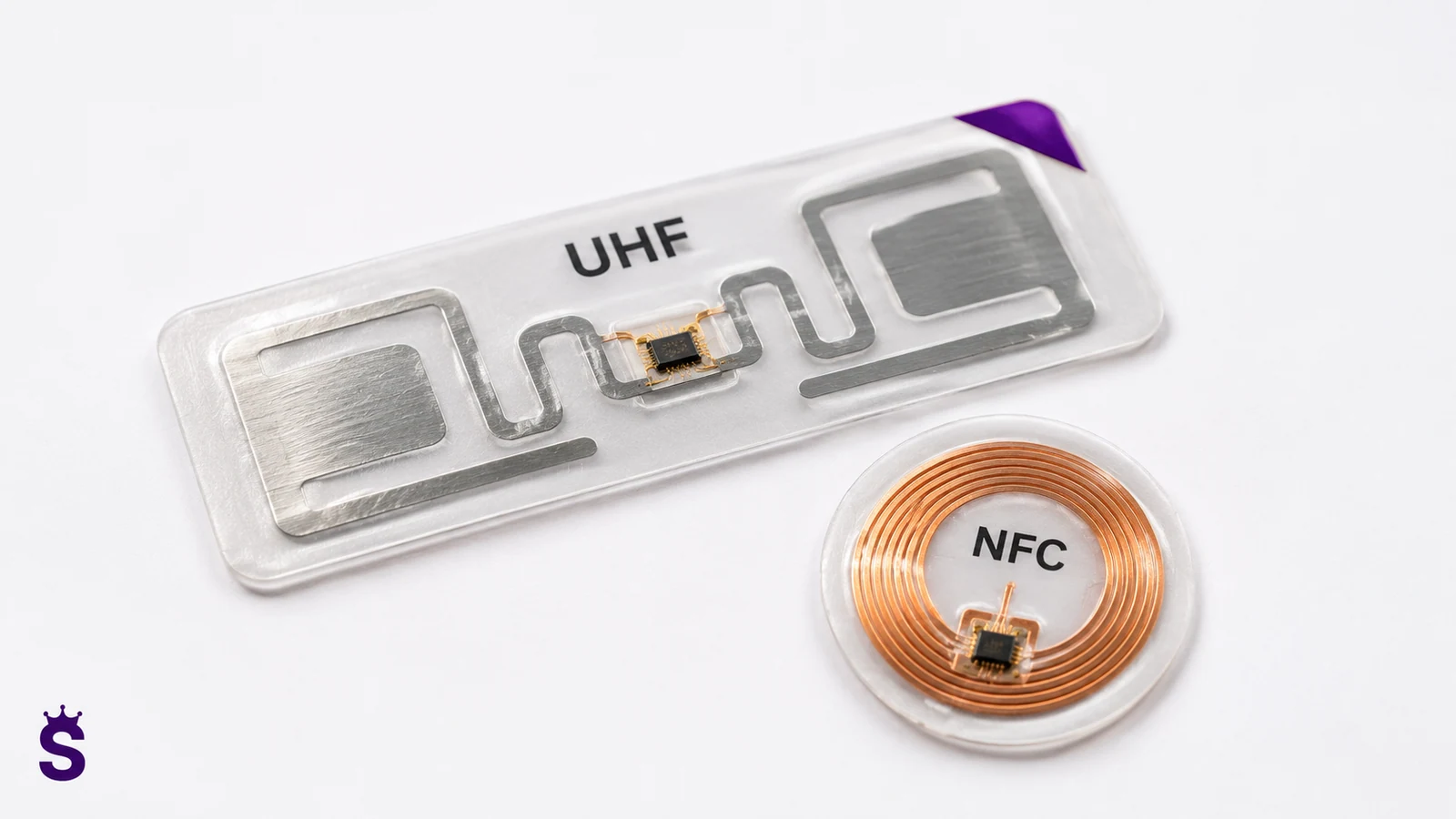
Both technologies are radio-based, but they solve different tasks. UHF is worth checking when reading batches and stocktake. NFC works well when the user has to consciously bring the phone or card to a selected point.
Start with the operator's action
| Question | Passive UHF RFID | NFC |
|---|---|---|
| How does the user work? | Reads tagged items in a prepared scope. | Brings a compatible device closer to the selected tag. |
| Typical task | Inventory, batch control, search for marked items. | Open information about the selected object or intentional interaction. |
| Equipment | Compatible UHF reader and antenna. | Compatible phone or NFC reader. |
| What needs to be checked? | Tag, area, zone and adjacent readings. | Phone compatibility, tag type and mounting conditions. |
A phone with NFC will not automatically read UHF tags. An appropriate reader is needed to work in UHF. NFC operates in the 13.56 MHz band; describes the characteristics NFC Forum.
Describe the user action and the required read result first
If an employee needs to intentionally point to a specific machine, a short NFC contact or QR scan may be convenient. If it is to check multiple marked tools in a batch, it is worth testing UHF. The technology is selected according to the activity, not the fact that both are wireless.
Write down what should happen after diagnosis: opening the record, adding it to the list or preparing the operation. The reading itself does not have to validate anything. Separating identification from operator decisions reduces the risk of accidental issuance or correction. Many things require list control and handling of identifiers that the system does not know.
Smartphones and handheld terminals: different ways of working
An NFC phone can support compatible tags within the limits of device and application capabilities. For this reason it is not a UHF reader. For UHF, you need an appropriate module or a separate reader, as well as software supporting a given method of operation. Band, protocol and application compatibility must be confirmed together.
At the handheld terminal, assess ergonomics, operating time, result visibility and data transfer method. On the phone, check the actual models used by the team, the case and the mounting conditions of the marking. Demonstration with one device does not confirm the operation of the entire fleet. The scope of mobile reading is described Service-King Mobile, and a selection of markings RFID tag page.
Example: a machine and room equipment
At the machine, the user wants to open exactly one documentation tab. Targeted NFC pinch or QR scan fits the bill. When registering a room, the operator wants to detect many marked things - it is worth testing UHF here.
You don't have to choose one technology for all tasks. What is more important is linking identifiers to the right records and clear operation rules. Double marking should not create two assets in the record.
Mounting and safety still matter
The metal and structure of the object can affect the reading of both solutions. Match the marking to the surface. A public link on a tag should not provide uncontrolled access to internal documentation or personal data.
The ID itself is not universal proof of user authority. Access control must be planned separately from opening the record.
Two technologies can identify the same item
An employee opens machine information on a smartphone while a storekeeper checks its equipment with a UHF handheld reader. A shared asset record need not use the same data carrier for both tasks. Avoid mixed identifiers when replacing labels or importing data. Test unavailable internet and denied document access, including the messages shown to the operator.
Related topic: machine card.
One item can support several compatible identification methods
| Task | Candidate for probation | What to check |
|---|---|---|
| Open the machine card | NFC or QR. | Phone compatibility and documentation access. |
| List of room equipment | UHF. | Skip and adjacent reads. |
| Single instrument issue | QR, code or UHF at the controlled point. | Clear selection of the right item. |
| Inspection of textile batches | UHF with laundry tag. | Actual input and process parameters. |
| Confirm the selected point | NFC or code in agreed procedure. | What is confirmed by reading and what is confirmed by performing an action. |
Plan data access separately from the type of data carrier
A tag may contain an identifier or address that links to the information. This does not mean that every reader should see all the documentation. The internal card may require login. A public item identifier should not act as a universal password for sensitive data.
Test the photo of the code, the copied link and the device of a non-logged in user. The question is not only "will he read it?", but also "what will he see and what will he be able to do?" The access control project uses an appropriate authentication and authorization mechanism, not just the convenience of reading the marking.
How to conduct a comparative test
- Select one action and expected result.
- Prepare the finished object with the target surface.
- Check all device types used.
- Measure the full time to recognize and complete an activity.
- Practice no-read, mistake, and lack of permissions.
- Select the variant that meets your requirements at an acceptable cost.
Also evaluate the maintenance of markings and the possibility of replacing them while preserving the history. If two identifiers describe the same thing, both should link to the correct existing record.
Scenario: a machine record and a quick stocktake of its equipment
A technician wants the right documentation at a machine, while a coordinator needs to count equipment across several rooms. They need not use the same data carrier or device. The shared element is the asset’s identity in the system. A deliberate QR or NFC scan can support one task and UHF another, where the design and workflow justify it.
Prepare a test including both logged in and unlogged in entries. An open link should not automatically expose internal data, and access denied must be understandable. For the list, check the typical arrangement of equipment, adjacent tags and the absence of expected items. The result of each path is intended to correspond to the appropriate action: opening a card is not a review, and detecting a tag is not a check-out approval.
Then complete the marking replacement. The operator should know whether he is changing the tag of one technology, both data carrier, or the item itself. The history shouldn't split into two records. It's a good idea to keep the secondary identification and associated numbers so that a failure in one reading doesn't block every check. Such a mixed model is useful when its rules are simpler than the problem it is intended to solve.
| Area | Practical arrangement |
|---|---|
| record | One correct item identity. |
| Action | Separated data opening, inventory and operation. |
| Devices | Confirmed compatibility of both reading paths. |
| Access | Verified view of unauthorized persons. |
| Exchange | Preserving history when changing data carrier. |
| Exception | Alternate recognition in case of no reading. |
Selection checklist
- One thing or many things in a session?
- User's phone or company handheld terminal?
- What surfaces and installation conditions?
- What data should be public and what data should be public after logging in?
- What will the operator do if there is no reading?
See RFID basics and comparison with barcodes.
Questions worth clarifying before implementation
Is NFC a variant of RFID?
NFC belongs to the short-range communication technology from the HF family. In practical selection, however, they must be distinguished from UHF because they use a different method of operation and equipment.
Will UHF always be faster?
With one item readily available, additional equipment may not provide benefits. UHF is worth checking especially with multiple marked positions, but the result depends on the environment and the complete operation.
Can I keep QR as a secondary solution?
This is how you can plan a mixed model. Correct connections in the records and a clear procedure when one method of identification is unavailable are important.
Go to solutions related to this topic
- Choosing labels and tags - Designations for clothing, tools and other working conditions.
- QR codes and barcodes - Recognize a single item and access its data.
- Service-King Mobile - Tasks and readings on the handheld terminal.
- RFID reading points - Zone readings and preparation of operations rules.
Sources and further verification
Free consultation
Let's match the technology to your workflow.
Tell me if you want to read one thing with your phone, count many pieces or control the passage. We will compare appropriate markings and devices.
Thank you for your inquiry.
Your message has been sent to the correct department. We will contact you to determine next steps.
Send another inquiry