

Industries • RFID laundry
Full visibility of textiles in your laundry
From accepting dirty laundry, through ironing, to packaging and delivery to the customer. Shorten counting time and reduce disputes over missing items.
Laundry: before and after RFID.
From manual counting to bag reading and checking a clean set.
Service-King for laundry allows you to control textiles at every stage of the circulation: from receiving dirty laundry, through washing and ironing, to packaging and delivery to the customer. The system uses RFID tags sewn in, welded or placed in laundry pockets. Reading can take place through automatic gates, manual gates with a touch screen, points on the countertop, under the countertop and roller conveyor solutions.
Daily macro challenges
Every day, hundreds or thousands of items go through the laundry process: clothing, bedding, towels, tablecloths, aprons, uniforms, hotel, hospital and industrial textiles.
The problem begins when you have to answer the questions:
- How many pieces arrived from the customer?
- What's currently in the laundry?
- What came out of the mangle?
- Does the item still have an RFID tag?
- What was released?
- What was lost, destroyed or returned to the wrong customer?
Service-King for laundry allows you to organize the entire textile flow and automatically record their passage through subsequent stages of the process.
RFID in the laundry room - textiles that "report" themselves
Each piece of textile can be marked with a UHF RFID tag. Thanks to this, the system can recognize specific items without manually entering numbers, looking for tags and scanning each code separately.
How can textiles be marked?
We select the marker according to washing, temperature, chemicals, ironing and everyday use.
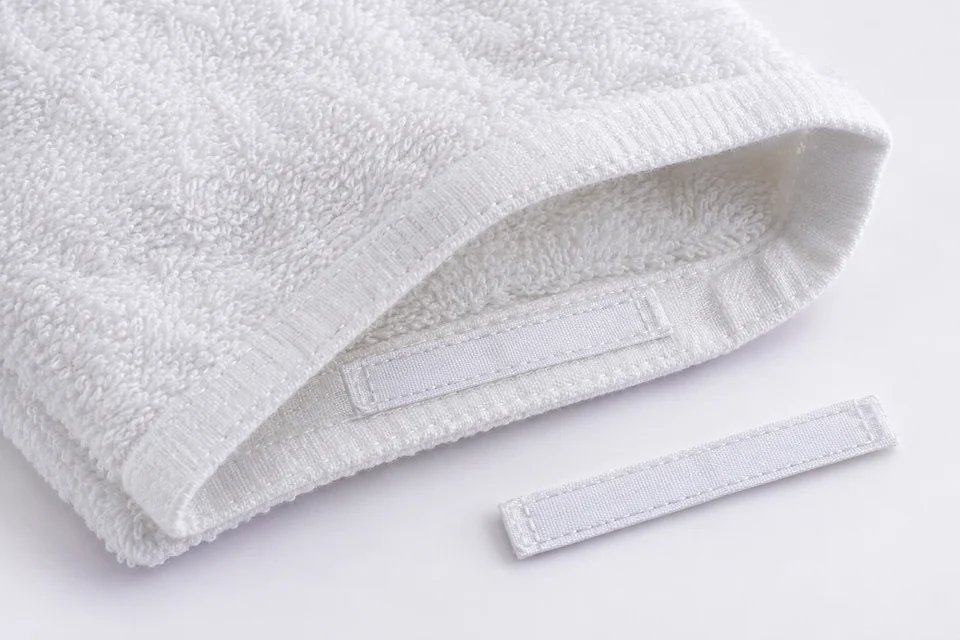
Three textile marking methods
Heat-Seal
Application of the appropriate marker using a press, e.g. on flat textiles: tablecloths and sheets.
Sewing
Placing a tag in a seam or hem, e.g. of a towel. The marking remains discreet.
Laundry pocket
Tag placed in a fabric pocket, matched to the textile and process.
RFID gates in the laundry room
The choice of station depends on what you want to control: batch flow, receipt and check-out, or reading of a specific batch. This is what the tabletop variants of the SK Gate AiO might look like.
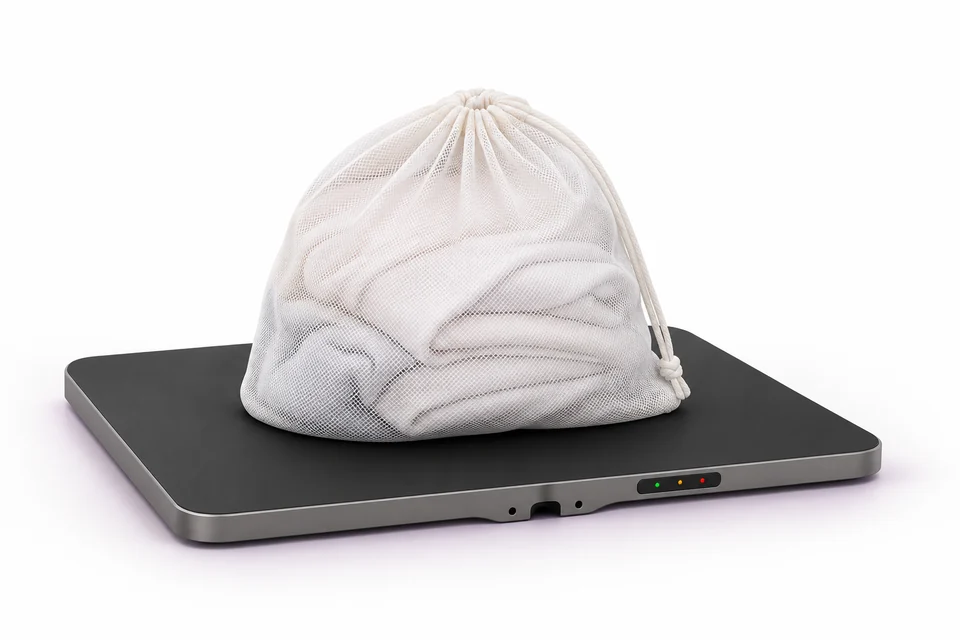
Flow monitoring
Reading without operator intervention and transfer of textiles to one defined place. This variant does not generate receipt or issue documents.
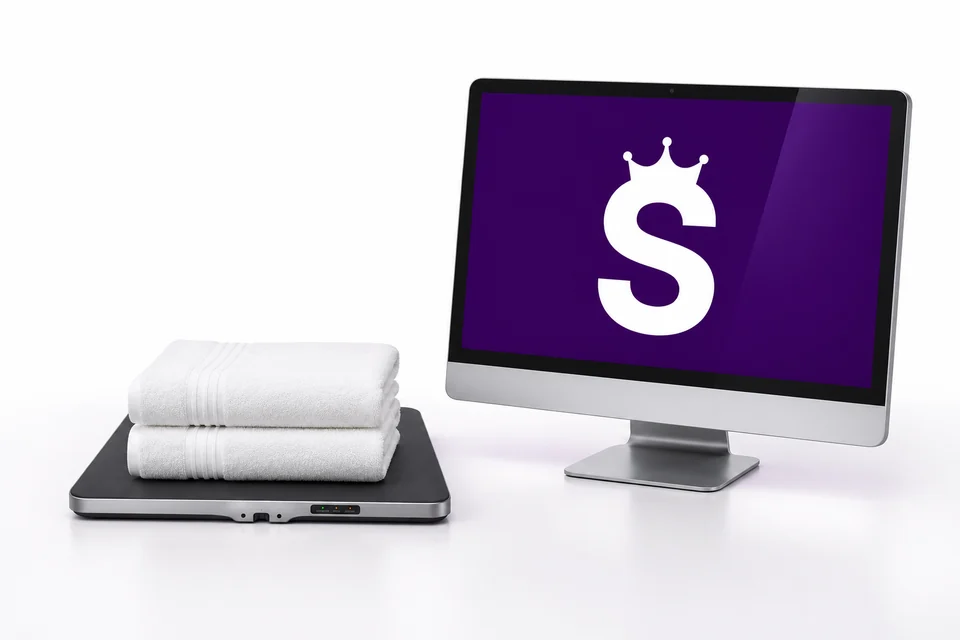
Receipt and screen check-out
The operator sees the readings and commits the operation: receipt, issuance, change of status or verification piece or lot.
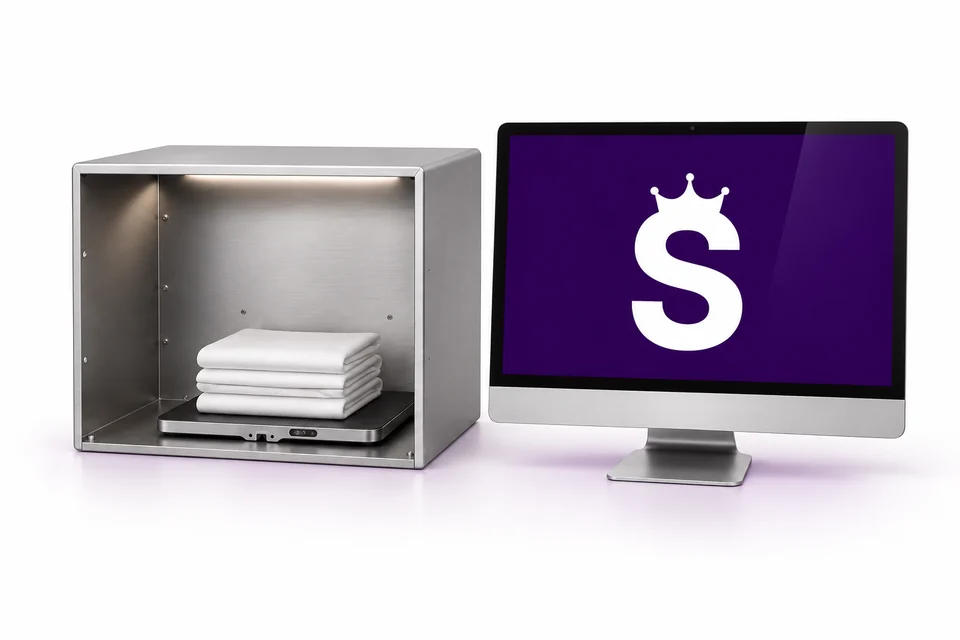
Separate reading zone
Features of the manual variant in the bodywork that helps limit ambient readings, e.g. adjacent bags. We select the structure according to the installation.
The visualizations show example variants according to the SK Gate AiO catalog. The configuration of the antennas, housing and reading is selected depending on the installation location.
Side-by-side control and Live Boards
These are the ideal points for real-time process visualization.
Monitor before mangle
- What just goes into the ironer?
- Which customer does the assortment come from?
- How many pieces are waiting for processing (queue)?
- Are there textiles from different customers (risk of substitution)?
Monitor after all
- What came out of the mangle and who does it belong to?
- How many pieces have already been processed?
- Does the RFID tag still work?
- Are there any shortages or unidentified textiles?
Laundry Customer Portal
The laundry can provide the customer with a dedicated portal with a preview its inventory, statuses and saved operations.
B2B Portal Features:
- His current range
- Textiles in the wash
- History of check-outs and returns
- Damage reports
- Statuses of individual pieces
- Customer zones (e.g. Floor, SPA)
Anti-theft gates at the customer's premises
The laundry service can extend the service to include textile inspection at the hotel. Installing RFID gates at the exits reduces losses resulting from "souvenir" behavior of guests taking out towels and bathrobes.
Who does this work for?
It works well where textiles are expensive, rotate frequently and, unfortunately, often disappear.
For Hotels and SPAs
Inspection of towels, bathrobes, bed linen, SPA textiles, napkins.
The hotel sees: what it has, what is in the laundry, what is missing.
For Hospitals
Bedding, medical clothing, ward textiles, bags, clean/dirty areas.
Greater control over epidemiological rotation.
For Restaurants and Catering
Tablecloths, aprons, kitchen textiles, returns, quality defects.
No more mistakes and no more charges for old stains.
Why does RFID make a difference in the laundry room?
Transfer records from paper calculations to digital radio precision.
Bulk read
Reading entire carts at once, without taking out pieces. Saving the employee's time.
Fewer customer disputes
You always have proof of how many pieces you have received. Digital documents end word-versus-word discussions.
Lifecycle control
Count laundry and verify recalls to ensure no guest or customer receives threadbare linens.
Full history
With each RFID reading, the textiles log the status and date themselves. You know everything about them.
Live Data/Monitors
The laundry room is alive, in each section you can see what needs to be done, who owns the cart and what is on the ironer.
Customer Security
You avoid accidentally packing Hotel A's expensive bathrobe onto a trolley for cheap Hostel B.
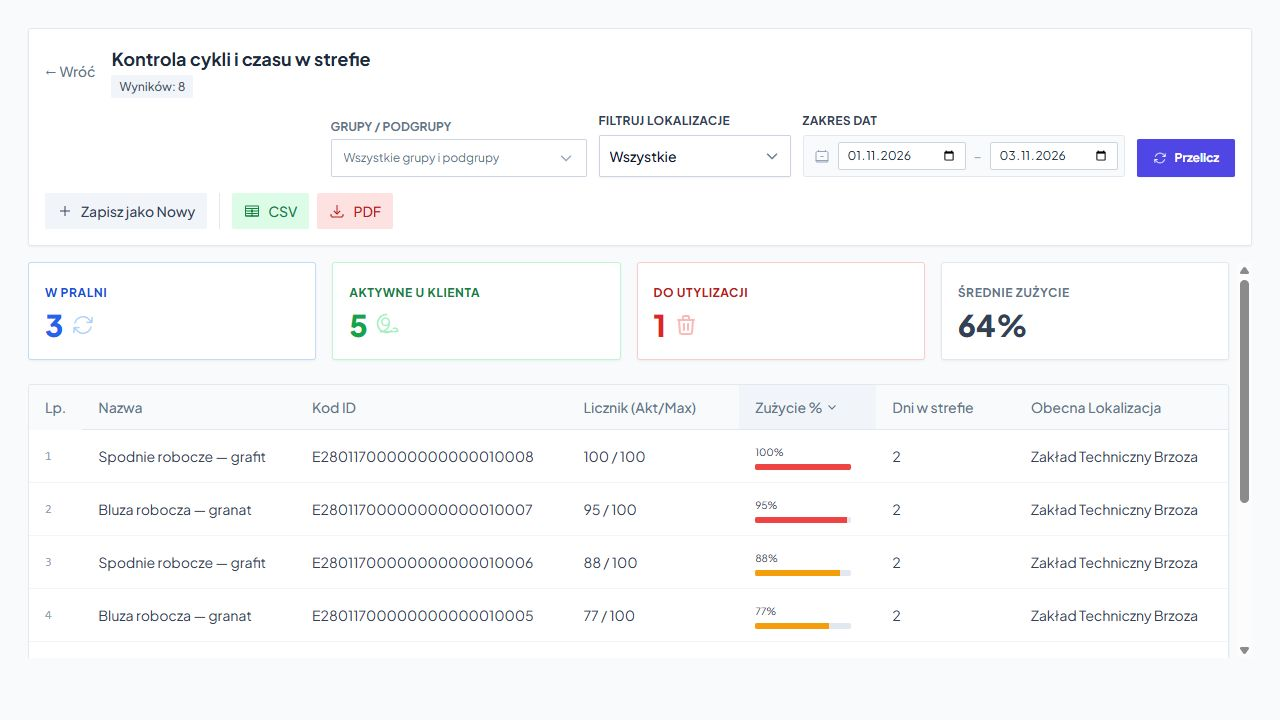
Preview of cycles and time in the zone
The counter shows the recorded cycles and the use of the set limit. Assessment of the physical condition of textiles remains a separate audit.
Free consultation
Do you want to control textiles in the laundry room without manual counting?
Service-King allows you to build an RFID process tailored to the laundry: from textile marking, through gates and reading points, to the external customer portal and live monitors in production.
Describe the type of textiles, the number of locations and the stages at which you want to check receipts, flow or check-outs.
Let's talk about your laundry room
Write what you want to sort out. We will select the scope of the conversation to suit your process.
Practical knowledge