

Knowledge base · Service-King
RFID or BLE? Identification, location and costs
Before you compare the price of tags, determine whether you need to recognize the item at the reading point, perform an inventory, or regularly receive information about its location. These are different requirements for infrastructure.
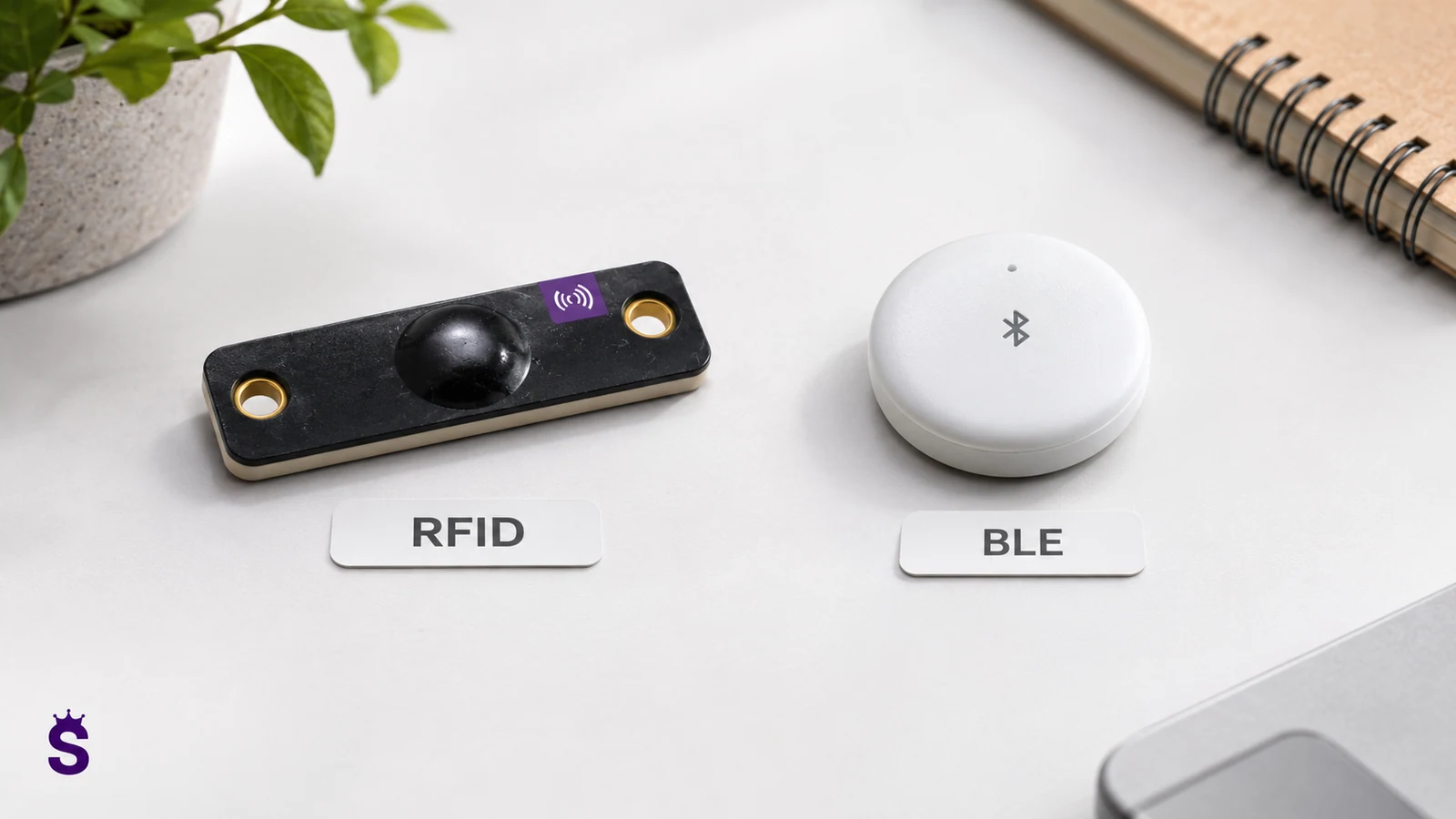
Don't compare technology names alone
A passive UHF tag responds to a reader signal and usually has no battery. An active Bluetooth LE beacon is a device that transmits signals according to a specific configuration and usually requires power. None of these components alone constitutes a complete localization system.
| Requirement | Question to solve |
|---|---|
| Stocktake or checkpoint | How to confirm presence and limit unwanted readings? |
| Location in the facility | What receivers, algorithms and coverage are needed? |
| Accuracy | Is a building or zone enough or do you need less uncertainty? |
| Maintenance | Who controls faucets, appliances and room layout changes? |
Write the requirement more precisely than "location"
For one company, it is enough to know that the tool has been delivered to the workshop. For the second group, presence in the room is important, and for the third person, regular positioning in a larger hall is important. These needs lead to different projects. The last workflows record, zone reading and current position measurement are not the same result.
Specify the area, update frequency and allowable uncertainty. Also record the behavior after no signal: does the user see the last known information with time, or does the item disappear? Without these arrangements, the comparison of offers will be limited to the tag price and the declared range, although the projects may address completely different needs.
Tag costs are only part of the total installation cost
Passive UHF can work without a tag battery, but requires a reader at the right place and time. An active BLE device typically has power that must be maintained. Both solutions include infrastructure devices, configuration, service and work related to updating data. A cheap tag does not automatically mean a cheaper system meets the requirement.
Add to the costs: replacing tags and batteries, changing the layout of the facility and maintaining integration. In practice, the availability of people responsible for the installation may be crucial. A solution that no one controls starts showing older and older data. Project RFID reading points should also cover the organization of maintenance.
When to consider each approach
UHF is a natural candidate for inventory and identification of marked lots. When providing information about passing through a gate, you also need to design the interpretation of the event. Bluetooth LE can be considered in solutions requiring active transmitters and receiving infrastructure.
Bluetooth LE does not guarantee single location accuracy. The result depends on the method used, installation and environment. Similarly, the last UHF reading is not automatically the current position on the plan. He writes about LE technology Bluetooth SIG.
How to compare the cost for the same need
Do not combine the price of a passive tag with the price of the entire active transmitter without taking into account the rest of the installation. Record the number of assets, area, frequency of information and method of maintenance. Add readers or receivers, assembly, configuration and operation of the devices to the cost. If once-a-day check-out confirmation is sufficient, continuous localization may be an unnecessary scope. If the item needs to be updated regularly, a mobile inventory alone may not meet the requirement.
Related topic: solution cost assessment.
Scenario comparison instead of one winner
| Scenario | Question for UHF | Question for BLE |
|---|---|---|
| List of multiple items | Do the tags and operator provide the required scope? | Are active transmitters needed for this purpose? |
| Pass through point | How to recognize the right batch and direction? | How will a transition event be detected? |
| Zone information | Does the arrangement of readers meet the need? | How do receivers and logic assign zone? |
| Regular item | What infrastructure and method is required? | What location method and accuracy test result? |
| Maintenance | Who controls points and tags? | Who maintains the transmitters, batteries and receivers? |
The trial must cover obstructions and movement
The result obtained in an empty hall does not describe work with full shelves, people and machines. Check typical obstacles and difficult places. If you are grading an item, compare it to an established benchmark and record the error distribution, not just the best score. Declaring one accuracy without conditions says little about usability.
Omissions and false events will be important for the transition point. For inventory - completeness and exception control time. For search - the ability to find the specified item in a typical zone. Each scenario has different reception criteria, so it is worth going through them with the target user.
When simpler records are enough
If the problem is mainly outdated check-outs, tidying up forwards may provide more benefit than installing a contiguous localization. It's worth first determining when users lose information about things. Not every “where is?” requires coordinate measurement.
In Service-King you can combine markings with records and history. The specialized scope of the location should be confirmed based on the infrastructure design. A separate scenario is used to find a specific tag within the operator's scope RFID search.
Scenario: which room is the device in?
The user says location, but may need several different results. The last transfer to room A may be enough to start the search. However, if an item changes location frequently without the operator's involvement, an infrastructure that provides subsequent confirmations may be needed. The requirement should describe the information and its freshness. Only then can technologies be compared on the same basis.
In the pilot, define known locations and follow a typical movement route. Record update times, ambiguous cases and signal loss. If the system identifies a room, test the boundary between adjacent rooms. Evaluate more than the best-performing locations. Multiple floors or changes in equipment layout can create conditions unlike those in the initial demonstration.
Finally, ask the user if the result actually shortened the action. Indicating with a delay or without information about uncertainty may lead to searching in the wrong place. The cost of the project should include maintenance of the sources and reassessment after facility changes. For some companies, a simpler record of workflow will be sufficient; for others it will only be the basis for a more complete localization. It is important that the choice results from the need, and not from the name of the solution itself.
| Area | Practical arrangement |
|---|---|
| Needed | Latest zone or regularly updated information. |
| Freshness | Allowable delay for user decisions. |
| Borders | Test of adjacent rooms and floors. |
| No signal | Visible age of last confirmation. |
| Maintenance | Batteries, receivers, readers and configuration. |
| Effect | Time of actual discovery or decision. |
The trial should measure the outcome you require
- Select items to recognize or locate.
- Set the expected update frequency.
- Check your score in obstructed and crowded areas.
- Calculate the cost of the entire installation and maintenance, not just the tag.
- Agree behavior after loss of signal or power.
At Service-King, we first determine the purpose of identification and workflow. Location needs require confirmation of the scope of infrastructure. Read also on combining GPS and RFID and RFID basics.
Questions worth clarifying before implementation
Does BLE always need batteries?
Active transmitters used in typical designs require a power source; its type depends on the device. You need to check the specific design and operating conditions rather than adopting one replacement interval for all models.
Does passive UHF tell you where you are?
The tag responds within range of the correct reader. The interpretation of the location and event depends on the installation and system rules. This is not an independent GPS positioning.
Can technologies be combined?
Yes, as long as each provides the necessary information and the data is correctly associated with the resource and time. However, the merger requires agreed integration and presentation of the limitations of individual sources.
Go to solutions related to this topic
- RFID reading points - Zone readings and preparation of operations rules.
- RFID Finder — Search for a specific item marked with the appropriate handheld terminal.
- Choosing labels and tags - Designations for clothing, tools and other working conditions.
- The implementation process - Process analysis, markings, tests and assembly commissioning.
Sources and further verification
Free consultation
Let's define the location information you need.
Describe the area, asset type and update frequency. We will select the scope of identification or infrastructure to be checked.
Thank you for your inquiry.
Your message has been sent to the correct department. We will contact you to determine next steps.
Send another inquiry