

Knowledge base · Service-King
RFID in the library: collection inventory, HF, UHF and compliance
Records of collections, loans and control of facility equipment have different needs. It is not enough to buy any RFID tags to work with the existing library and its devices.
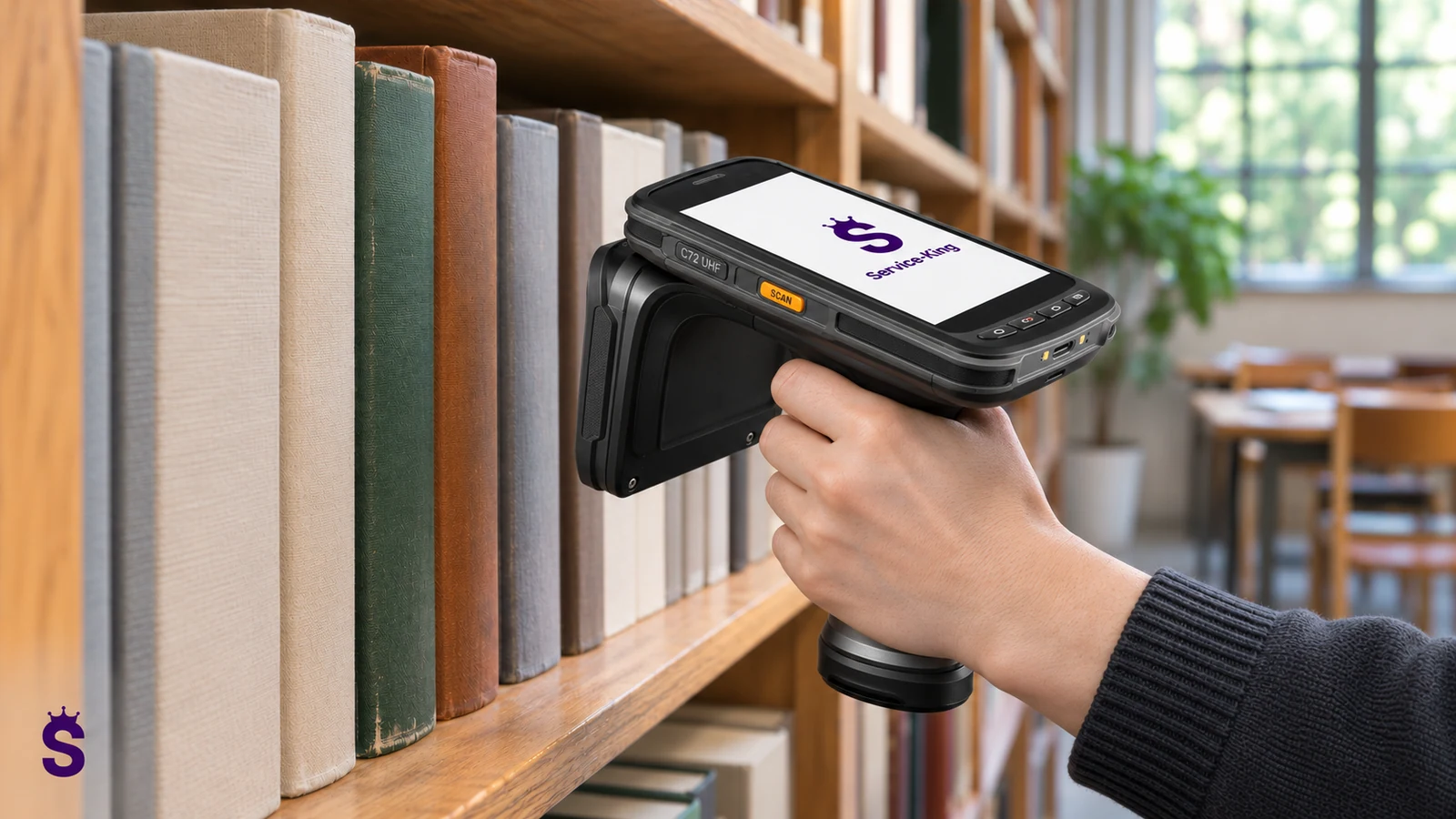
Check your existing installation first
Specialized RFID solutions and library systems can be found in libraries. frequency band, protocol, data structure and devices must be compatible. The UHF storage tag is not a universal replacement for every library tag.
| Area | What to confirm |
|---|---|
| System | Required format and interfaces. |
| Equipment | frequency band, protocol and reader compatibility. |
| Assembly | Place and influence on a book or document. |
| Process | Inventory, rental, return or passage protection. |
Compatibility covers the frequency band, protocol and data
Two products described as RFID do not necessarily work together. The library system may expect a specific frequency band and data structure. The UHF stock tag is not a universal replacement for the library tag.
Before purchasing, collect the requirements of your system and devices. Check out a sample of the new markings and how to program them. It is important not only to detect the tag, but also to correctly recognize the record and function. Compliance must be confirmed with the suppliers of the relevant components.
Book collections and equipment have different procedures
The catalog, loans to readers and collection control are part of specialized workflow. Laptops, projectors, furniture and technical tools may be kept in equipment records. There is no need to pretend that one generic module will replace all institutional requirements.
You can discuss in Service-King equipment of an educational institution and property of a public institution. The scope of integration with the catalog and required documents must be confirmed separately. Separating these areas allows you to streamline the facilities without violating the rules for registering collections.
Reading tags does not replace a complete collection audit
Quick recognition of flagged items can improve inspection, but the result requires comparison with the appropriate records and explanation of exceptions. Formal rules for the inspection and recording of collections should be established for the institution. They are not automatically replaced with the list of read tags.
In the archive, proper identification of units and protection of documents are also important. The marking method must be approved before serial assembly.
Keep facility equipment separate from the book collection
Laptops, projectors, furniture and technical tools may be maintained on Service-King equipment records. This is a different scope than the library catalog and reader services. Do not assume that one generic module will replace a specialized library system.
For equipment, it is worth starting with the location and people responsible. RFID or QR is selected for specific items and the method of inventory.
Keep the item identity when replacing a tag
If a tag stops working, a new ID must be assigned to the appropriate existing record according to library system rules. You should not create a new item just to make it readable again. A similar logic applies to technical equipment: replacing a tag should not delete the check-out and control history. In both areas, it is necessary to try to recognize things in a different way, e.g. based on a readable number and documentation.
Related topic: additional means of identification.
Comparing collection management with support equipment tracking
| Task | Information needed | Proper control |
|---|---|---|
| List of collections | Identification consistent with the system. | Comparison and explanation according to institution procedures. |
| Loan to reader | Correct record and authorized workflow. | Integration with a specialized system. |
| Laptop issue | Item and person. | Document and return of the set. |
| Transfer of equipment | Location and history. | Confirmation of actual movement. |
| Archive | Appropriate entity and documentation. | Safe marking principles. |
Installation and replacement require continuous identification
For books and documents, the assembly method should comply with the institution's rules. The material and the method of subsequent handling must be taken into account. A corrupted tag should not cause a second item of the same item to be created.
First recognize the existing record in a different way and assign a new tag according to the system rules. A similar logic applies to technical equipment. The history should remain the same, despite the change in the identification load carrier.
How to prepare a pilot
Select a representative scope and set a goal: compliance, inspection time or equipment workflow. Check for correct readings, unknown ID and invalid tag. When furnishing, also include handover and return.
Formal inspection and documentation rules should be established for the institution. The reading list does not replace the entire procedure. For physical assets, the starting point may be RFID stocktaking with a clearly defined scope.
Scenario: replacing a tag in an existing copy
The marking stops working, but the book or document still has its identity in the records. First, identify the correct record according to your institution's policies. Load carriers replacement should not automatically create a second item. Maintain relationship with history and required documents.
Check the compatibility of the new tag with the system and devices. The mere fact that the reader detects a mark does not confirm the correct format and function support. In a specialized library system, specific data structures and programming procedures may be important. These must be confirmed with the relevant supplier.
Installation should comply with the principles of material protection. Markings should not be arbitrarily removed or attached if this could damage the object. Proper acceptance is required in archives and special collections. The records of technical equipment may have different rules than the book collection.
In the sample, also check the reading of the old marking if it remains physically present. It should not introduce ambiguity into the current process. Determine how the exchange is documented and who can perform it. The operator should understand that the history is about the same thing despite the change in technical identifier.
It is worth performing such a scenario before purchasing a larger batch. It allows you to assess compliance and service organization, not just a new tag in ideal conditions. For Service-King, the scope of the facility's equipment and possible connections with a specialized collection system should be determined separately. They are not an automatic consequence of the common RFID name.
| Area | Practical arrangement |
|---|---|
| Record | Correct existing item. |
| Standard | Band, data and feature compatibility. |
| Assembly | Material safe principles. |
| Old tag | No ambiguity in current workflow. |
| Permissions | Person performing and documenting the exchange. |
| Scope | Collections separated from technical equipment. |
Checklist
- Distributed collections and equipment.
- Confirmed compliance of markings with the system.
- Accepted installation method.
- Exceptions described and differences explained.
- Sample on a representative portion of the stock.
See RFID stocktaking in Service-King and inventory of equipment of the educational institution.
Questions worth clarifying before implementation
Will a phone with NFC read every library tag?
It depends on the standard, device and application. Compatibility should be checked and not assumed based on the RFID name alone.
Does Service-King replace the library catalog?
This should not be assumed. The scope of equipment and specialized collection workflow must be separated and the requirements confirmed.
Can existing markings be retained?
It is worth assessing them in terms of standard, condition and data. Suitability in the new process depends on the compatibility of the entire solution.
Go to solutions related to this topic
- Educational equipment — Records of equipment in rooms, laboratories and facilities.
- Public institutions - Order in equipment and responsibility for property.
- RFID stocktaking — Physical inventory and comparison of the reading with the records.
- Property records - Records of company equipment and fixed assets.
Free consultation
Let's distinguish collection needs from facility equipment needs.
Describe the current library system and audit assets. We will determine the compliance of the markings and the appropriate scope of the records.
Thank you for your inquiry.
Your message has been sent to the correct department. We will contact you to determine next steps.
Send another inquiry