

Knowledge base · Service-King
Cost of lost equipment: search, replacement, downtime
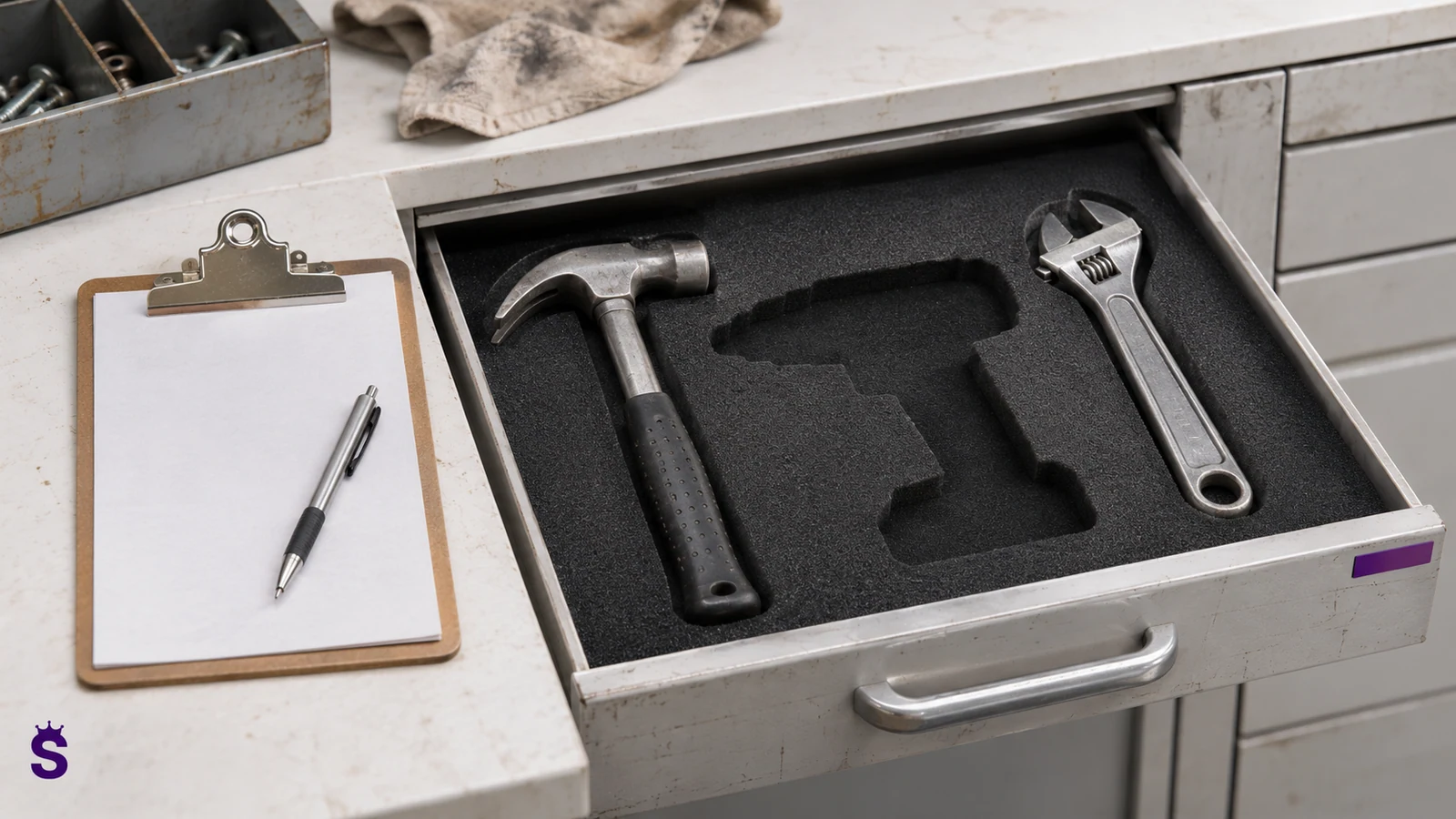
A lost power screwdriver also means searching, downtime and additional checking out. To assess the scale of the problem, separate the actual loss from working time and costs that would have occurred regardless of the event.
Break down the cost of a single incident
| Position | How to count |
|---|---|
| Search | Each person involved's time × the full cost of their hour. |
| Replacement purchase/rental | Actual expense related to the event. |
| Replacement delivery | Transportation and additional work, if any. |
| Downtime | Documented impact on work, no double counting of the same hours. |
| Event handling | Time for clarification, documents and updating of records. |
Do not automatically add up the price of old equipment and the full price of replacement equipment as two independent losses. The method of calculation depends on the purpose: cash cost, economic cost or accounting data are different perspectives.
The purchase price does not show the full impact of an incident
The lack of one device may involve a warehouseman, a manager and two employees. In addition, there is a call to another branch, a trip to pick up a replacement and a change in the order of tasks. It's a good idea to write down these items separately because not all of them represent a cash expense. Working time, loss of value and additional payment are different types of cost. Separating them protects against overbilling.
First, define the purpose of the analysis. The number of hours will be useful for organizing work, the full cost of the solution for purchasing decisions, and appropriate data on assets for accounting. There is no need to turn everything into one flashy amount. It is better to show: how much time was wasted, what the actual additional expense was and which assumptions are only estimates.
An incident log provides a firmer basis than recollections
For a set period of time, record each search that ends with an inspection or replacement purchase. Record the item, number of people, time and result. Separate equipment found elsewhere from equipment that is actually lost. If the RFID reading is missing, check whether it was due to the tag, radio conditions or a missing item. Without splitting the causes, it is unclear which part of the problem the system can solve.
Compare periods with similar workloads. A month of many events is not equivalent to a quiet week. Measure time per defined number of check-outs or events so that an apparent improvement is not merely the result of less activity. Individual item investigations are supported by operation history and reports.
An example of valuing time, not a promised result
How records reduce guesswork
The last valid check-out indicates where to start the explanation. The history of returns and transfers helps distinguish between a loss and an item being put away. Failure to read RFID is not a stand-alone proof of loss. First, the documents, markings and reading conditions are checked.
Searching for a specific tag can help with the handheld terminal's coverage zone. It does not replace complete information about the workflow. The best result is a combination of markings and a consistent record of operations.
Compare purchase vs reuse
Before purchasing a replacement, check items available at another branch and devices returning from service. Found item can solve a need without a new expense. However, this does not mean that every missing item can be recovered. It is worth recording how many purchasing decisions were actually changed after checking the records. This result is a better basis for analysis than assuming that the entire loss cost will disappear after implementation.
Related topic: ROI calculation example.
Example calculation with separate cost categories
| Item | Assumption | Result |
|---|---|---|
| Search | 3 people × 20 minutes × PLN 60/h. | PLN 60 time value. |
| Transfer to a replacement | 1 person × 40 minutes × PLN 60/h. | PLN 40 time value. |
| Substitute lease | Actual fee for the agreed period. | Amount from the document, if any. |
| Finding old equipment | Equipment returned to workflow after inspection. | There are no grounds for calculating the permanent loss of the entire value. |
| New system | Commissioning and maintenance during the period under review. | Cost deducted when assessing profitability. |
In the example, hours are the valuation of the labor asset. The hour recovered does not automatically translate into payroll savings. When deciding on implementation, you need to show how it will be used.
How to choose an improvement for the most common cause
If outdated transfers are a problem, start with check-outs and returns. When items have the correct records, but it is difficult to find a specific item in a zone, you can check RFID search. If the equipment returns damaged and is available, a condition check is required after return. Each cause requires a slightly different change.
The best pilot is for a group for which you have a point of reference and the ability to compare. Don't assume that all shortages will go away. Check how many incidents were resolved faster, whether the number of unjustified purchases decreased and how much it costs to maintain the process. It will be helpful ROI RFID guide and a calculator based on your data.
Scenario: calculating one month's costs without overstating them
Prepare a simple log of events and record them for an agreed month. For each shortage, note the type of equipment, number of people, approximate time, and completion. Separate cases resolved on the same day from those still open. Do not add a permanent loss where the outcome remains undetermined. This will make the analysis useful even if some of the equipment is found later.
After the period, total the hours and actual additional expenses separately. If one person went to pick up a replacement during the time already included in the downtime, check whether you are not counting the same work twice. For several people, do not automatically add up the entire duration of the event if only some of them were involved. Record your assumptions so that another person can repeat the bill, not just see the final amount.
Then assign events to causes: wrong location, missed handoff, missing identification, equipment in service, or actual loss. The design of the records should respond to the prevailing problem. If most of the time is taken up by an outdated assignment, the pilot should primarily check handoffs. If equipment is correctly assigned but is difficult to find, compare tags and search. Only after the change, repeat the measurement on a similar range and also assess the cost of maintaining the new process.
| Area | Practical arrangement |
|---|---|
| Scope | Same type of operation and comparable load. |
| Time | Actual commitment of individuals. |
| Expenses | Separate from hourly valuation. |
| Result | Equipment found, lost or still being investigated. |
| Reason | Basis for selecting an improvement. |
| Comparison | Measurement after change and full solution cost. |
How to measure the effect of a change
- Collect comparable events over a set period.
- Record search time and number of people.
- Separate found and actually lost equipment.
- Include the cost of data preparation, marking and system maintenance.
- Compare similar scope of work before and after the change.
You can convert your own assumptions in time and ROI calculator. How to record a workflow can be found in Tool Control and tool crib guide.
Questions worth clarifying before implementation
Is purchasing a replacement always an additional cost for loss?
You need to determine what happened to the old item and what the purpose of the bill is. If the equipment later came back into use, the full value of the loss and the price of the new purchase cannot be added up as two independent losses without explanation.
How to calculate downtime?
Based on actual impact on the task, with clear assumptions. If the same hours are already included in the time of the people involved, they should not be added again without separating the scope.
Will the RFID finder provide a location on the map?
Mobile search helps you find a specific tag within the reader's reach. It is not automatically a continuous position measurement. Mapping and site infrastructure are another scope of the project.
Go to solutions related to this topic
- Inspection of tools and equipment - Specific pieces, check-outs, phrases and history.
- RFID Finder — Search for a specific item marked with the appropriate handheld terminal.
- Reports and movement history - Statements and documents related to operations.
- Tool cribs in practice — Preparing equipment, issuing it to the employee and settling the return.
Free consultation
Let's see how long it takes to find equipment.
Describe a typical event: who is searching, for how long, and what happens next. We will help you choose the records and method of measuring the effect.
Thank you for your inquiry.
Your message has been sent to the correct department. We will contact you to determine next steps.
Send another inquiry