

Knowledge base · Service-King
Entrusting equipment to an employee: registration and return
Who picked up the tool, what was included in the set and in what condition did it return? Well-kept records organize the facts. However, it does not replace the legal principles of employee liability.
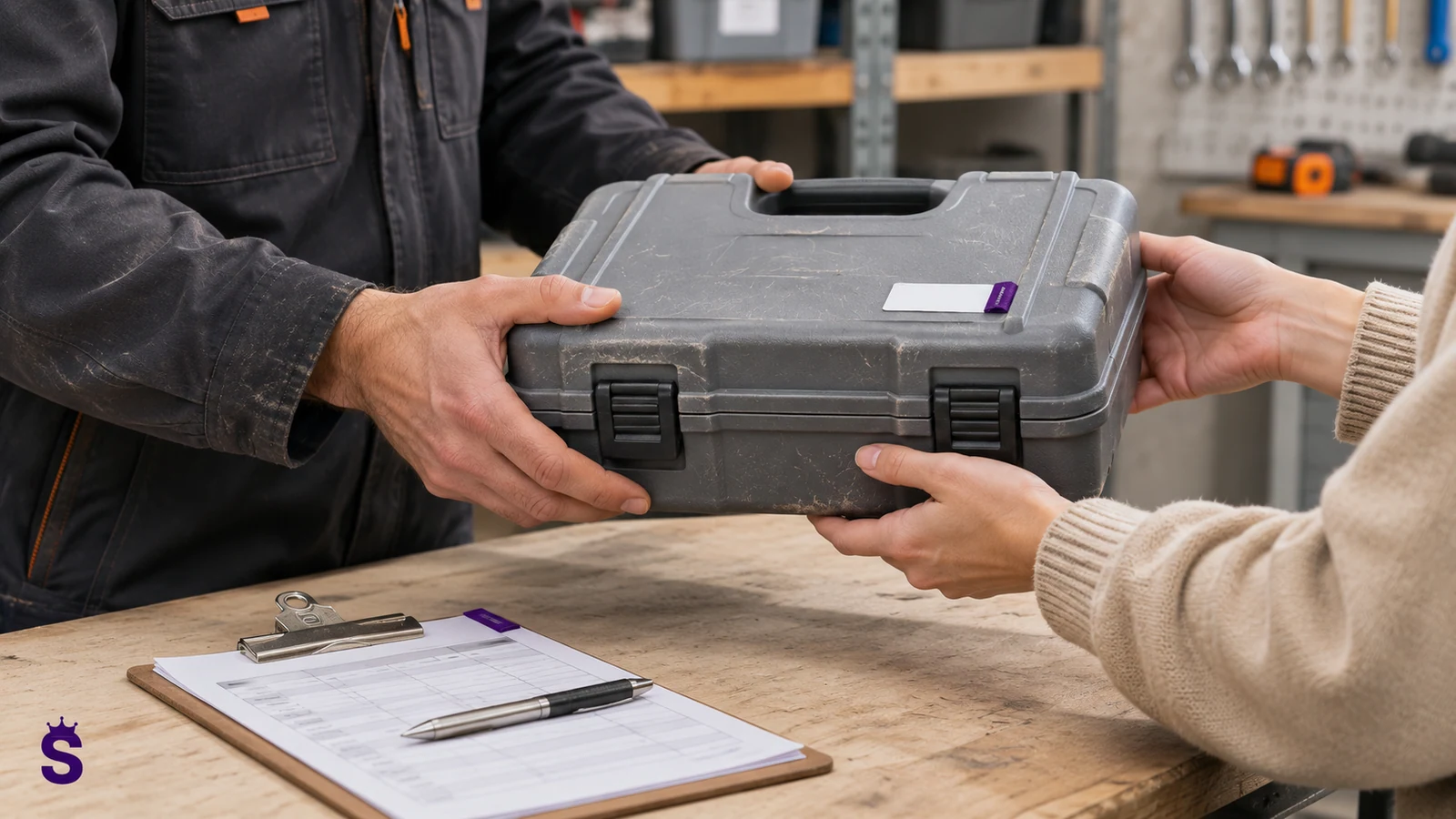
The check-out record should reflect the actual handover
The check-out should indicate the person, date, specific pieces and scope of the set. Add condition and important notes so that your return isn't based solely on memory. The signature or acknowledgment must refer to the actual content of the document.
| Information | Why it helps |
|---|---|
| Identification of items | Distinguishes similar items. |
| Set contents | Lets you tell what was supposed to come back. |
| Condition and comments | Separates earlier damage from later observations. |
| Person and date | Organizes the transfer process. |
| Return or forwarding | Ends or continues the actual history. |
The document should let you reconstruct the handover
In a dispute, the problem is often not the lack of a signature, but the unclear content of the list. The name "toolkit" does not make clear whether it included two batteries and a charger. The model number does not distinguish several identical devices. The description should indicate a specific item or a clearly defined quantity and the contents of the set. This provides a basis for comparison upon return.
It is a good idea to write down important notes about condition, previous damage and limitations of use. There is no need to create extensive documentation of every small activity. What is needed is a scope adequate to the risk and the adopted principles. In the system, an operation, a person and a document should refer to the same list, and corrections should have an understandable justification. The practical workflow is described tool control in Service-King.
Transfers between employees are part of the equipment workflow
Equipment may be transferred without returning to the warehouse: between shifts, teams or stations. If the record ends at the first check-out, the last visible user may not correspond to the actual mileage. Determine how you confirm such a transfer and who can approve it. A convenient process is more likely to be used than a complicated path avoided in a hurry.
It is also worth separating the person making the recording from the person receiving the equipment. The warehouseman may handle the operation for the employee, and the receipt confirmation may have a separate meaning. The history should show these roles without mixing them up. With employee access you can discuss view of your own equipment in the portalso that the user can check the assigned items in the provided scope.
A record does not automatically establish legal liability
The Labor Code distinguishes between the principles of liability for damage and for property entrusted with the obligation to return or account for it. The mere assignment of a tool in the application does not constitute an obligation to pay, the amount of damage or the possibility of deduction from wages. The circumstances, the correctness of the entrustment and the relevant regulations are important.
With joint liability, it is not enough to add several names to one list. The rules and documents should be agreed with the person responsible for HR matters or a lawyer.
What an individual item's history provides
In Service-King, issue, return and documents can be linked to the appropriate piece of equipment. RFID or QR shortens the recognition of items, and the operator confirms the operation. History helps reconstruct facts without adding assumptions about guilt.
Example: A tool was transferred from team A to team B without returning to the warehouse. If the record ends with the first issue, the record is incomplete. A clear transfer operation and confirmation from the right people are needed.
Which situations need separate procedures
| Situation | What to document | What not to automatically assume |
|---|---|---|
| Regular issue | Person, pieces, set and condition. | That the entry itself determines all legal consequences. |
| Partial return | Items returned and items remaining to be clarified. | That picking up the suitcase completes the whole set. |
| Damage | Symptom, condition and further evaluation. | That the report indicates cause or fault. |
| Transfer between persons | Actual movement and proper confirmations. | That the previous assignment still describes reality. |
| None | Inspection process, documents and findings. | That if the tag is not detected, it means missing. |
Separate fact-finding from employment decisions
Records capture the item, handover and condition. Employee liability requires an assessment of the legal conditions; a name in an app is not enough. Polish labour law includes rules for entrusted property that must be returned or accounted for. A compensation claim or wage deduction does not arise automatically from the check-out register. This explanation concerns Poland; local rules apply elsewhere.
It is worth agreeing the procedure and documents with the person responsible for HR matters or a lawyer. This applies especially to shared responsibility and equipment used by several people. In practice, a well-separated report of facts helps to conduct such an assessment more calmly: it is known what was issued, what was returned, what comments were made and which findings are still incomplete. They support the reconstruction of this data reports and workflow history.
Scenario: an incomplete return and a factual investigation
The employee returns the case and main device, but the list shows an additional battery. The operator should confirm the items actually received and leave the item open. There is no need to immediately decide why an item is missing. Fair receipt can separate the determination of scope from the subsequent assessment of cause. It is also worth recording the comments of both parties and the reference to the relevant issuance document.
Then check whether the battery was individually identified, belonged to a template, or was actually confirmed at check-out. This is an important distinction: an automatic list of expected accessories does not always prove that they have actually been provided. If there has been an exchange or transfer to another person in the meantime, the history should show this. A document-based explanation is more useful than just the name shown in the current assignment.
The final record should indicate which facts have been established and which remain uncertain. The decision on further action is made by the appropriate person in accordance with the organization's rules and the law. The system should not automatically turn a technical non-compliance into a finding of fault. Such organization helps both the company and the employee: it is known what equipment was billed, on what basis and what requires additional checking. It also limits repeating the same conversation with subsequent changes.
| Area | Practical arrangement |
|---|---|
| Waiting | List source and actual check-out document. |
| Receipt | Confirmed items without closing gaps. |
| History | Transfers, exchanges and early returns. |
| Notes | Facts separated from assumptions. |
| Rating | Appropriate personnel or legal responsibilities. |
| Closing | Clear result and related documents. |
Checklist for the company
- Agreed rules for the use and storage of equipment.
- Confirmation of check-outs and returns with item identification.
- Record of status and incomplete sets.
- How to report loss or damage.
- Separation of fact finding from personnel or legal decision.
The practical workflow is described on the page Tool Control. They are also useful for explanations reports and workflow history.
Questions worth clarifying before implementation
Does an electronic signature replace a paper document in every case?
The effect depends on the type of document, the form required and the method of confirmation used. Any click or signature image should not be considered a one-size-fits-all replacement for any legal form. Requirements must be established for a specific procedure.
Can I assign one set to several people?
The technical method of recording must be adapted to actual use and procedures. Joint material liability has separate legal conditions. A list of several users in the system does not create these conditions by itself.
Can the lack of RFID be the basis for settlement of damages?
No reading is a signal for inspection, not a final determination. You need to check the marking, range, documents and actual location of the item. Only more complete findings allow us to proceed to the appropriate procedure.
Go to solutions related to this topic
- Inspection of tools and equipment - Specific pieces, check-outs, phrases and history.
- Customer and employee portal - Records and notifications within the scope provided.
- Reports and movement history - Statements and documents related to operations.
- Health and safety equipment and assignments - Job Standards, Sizes, Preparation and Issue.
Sources and further verification
Free consultation
Let's organise your equipment handovers.
Show us how you confirm check-outs and returns today. We will select the method of identifying items and the documents needed to recreate the workflow.
Thank you for your inquiry.
Your message has been sent to the correct department. We will contact you to determine next steps.
Send another inquiry