

Knowledge base · Service-King
WMS in automotive: parts, batches and return load carriers
Similar parts, changing versions and site deliveries require clear data. The system is intended to help indicate the correct element and document movement, not only to shorten scanning time.
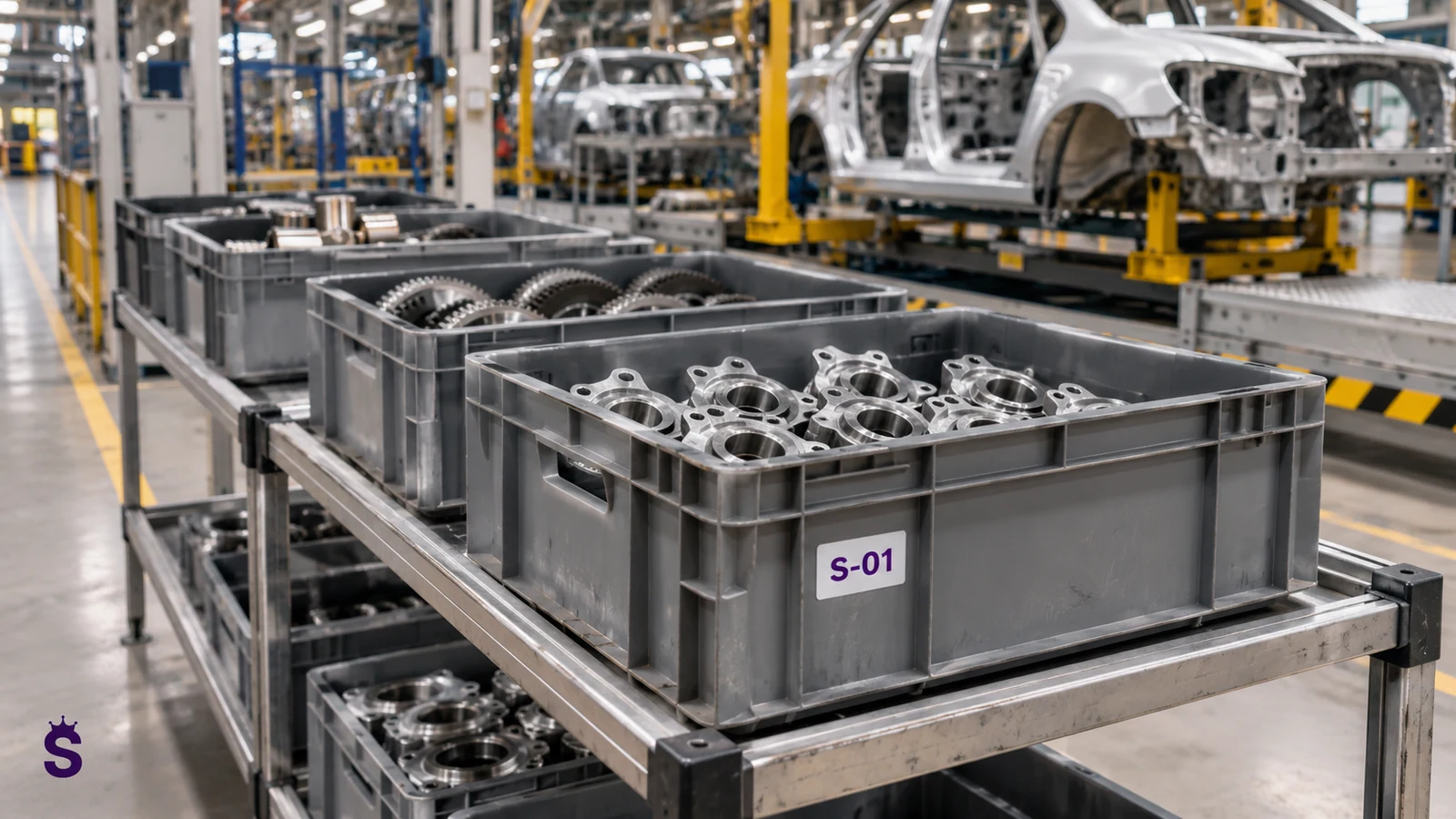
First, define the identification level
Catalog number, revision, batch and item are not interchangeable. Before selecting tags, determine which data must accompany the part in the process. In the case of tools and devices, the condition and required inspection dates are included.
| Object | Sample range |
|---|---|
| Wear part | Index, quantity and required batch data. |
| Serial item | Individual ID and history. |
| Measuring instrument | Item, condition and relevant inspection documents. |
| Transport container | Own load carriers identity and current content association. |
The part number does not fully identify an individual item
Depending on the process, the part number, revision, batch or individual item may matter. Define the data required at receipt and handover to a workstation. A similar part from a different revision may not be a valid substitute. Check against process requirements, not just the catalogue name.
Shared dictionary between warehouse and production limits manual matching. If two systems use different identifiers, an agreed relationship and change owner are needed. Importing new records without version control may deepen the problem instead of sorting it out.
Tools and fixtures have their own history
The material element may be accounted for in quantity, and the measuring instrument requires identification of specific items and documents. It is not worth mixing these needs into one general item. The availability of station equipment also depends on the condition and required inspections.
Service-King can combine records, issues and equipment history. Application example shows tool inspection and quality area. Industry requirements, documents and integrations must be confirmed separately; The RFID marking itself does not constitute process certification.
The read setup must suit the workstation
Metal parts, oils and tightly packed containers require practical tag trials. UHF can identify multiple tagged items faster, but should not capture unintended reads from an adjacent batch. Test read performance at the intended work rate and in the final layout.
Do not assume that the tag on the container proves all parts are present. If the content is bound to the load carriers by an operation, specify rules for updating it after unpacking or completion.
Separate equipment from production control
Service-King helps you record tools, devices, parts and load carriers and document their workflow. Planning deliveries in sequence, production accounting and integration with the line require a confirmed range of WMS, MES and ERP systems. RFID alone does not ensure process compliance or industry certification.
A good starting point is a group of instruments or a set of tools at a selected station. The test result should include data quality and exception handling.
Consider workstation tools and fixtures
Even when parts are billed correctly by the manufacturing system, tools and fixtures may remain on separate sheets. For such a group, the history of the item, condition and appropriate documents are needed. When changing positions, the transfer must be recorded. This is a separate, practical area of improvement that does not require declaring the reconstruction of the entire WMS. First, determine whether the problem is with the production material or with the equipment needed to do the job.
Related topic: instrument appointment control.
Compare the items before choosing a technology
| Object | Record level | Trial |
|---|---|---|
| Part | Index and required batch or item data. | Read in target package. |
| Device | Specific item and inspection documents. | Check-out and return of the correct item. |
| Tool | Model, item, condition and complete set. | Reading after mounting on the housing. |
| Load carriers | Persistent identity and current association with content. | Partial discharge and refill. |
| Machine | record, parts and service history. | Access to appropriate documentation. |
Test metal, oil and densely packed items together
Tag may work well on a single item but not in a tight container. The mounting location and design of the sign should take into account material, friction and cleaning. The trial should include the finished game in the typical rhythm of the station.
Also check adjacent containers. A large number of reads is not a success if some of them belong to another operation. With a fixed point, you need session rules and a response to the lack of the required item. The test result should be understandable to the production and warehouse operator.
Agree acceptance criteria with the production team
Prepare correct check-out, part return, version change, unknown index and communication interruption. Specify the binding source for states and records. If the project includes WMS, MES or ERP, agree on the division of responsibilities.
Practical pilot may concern one station or a group of instruments. It allows you to check usability without declaring the reconstruction of the entire factory. The method of data exchange is described warehouse and production integration guide.
Scenario: a different part revision reaches the workstation
The part has a similar name, but the required revision must be confirmed according to the process. If the code identifies only a general part number, a read may not settle the issue. First define the data required to approve the pick. Do not hide a revision mismatch by manually selecting the nearest item.
Check source for requirements and catalogs. Production and warehouse must use an agreed identifier relationship. When changing versions, you need a way to update and deal with previous stock. Otherwise, two locally valid systems may together lead to an incorrect forwarding.
Prepare an unknown index variant and a replacement requiring consent. The operator should be able to see why an item fails inspection and who can make the decision. It's not worth removing validation just because it interferes with the demonstration to complete the list. Its purpose should correspond to the actual risk and be understandable to the user.
After trying, evaluate not only the speed but also the number of manual exceptions. If every delivery requires catalog matching, the main work may be on data and integration, not on another reader. It is worth testing the station equipment separately, because the devices and tools have a different history than the material parts used.
| Area | Practical arrangement |
|---|---|
| Requirement | Index, version and other necessary features. |
| Source | Directory owner and changes. |
| Spare | Dealing with an earlier version. |
| Replacement | Consent and record of item actually issued. |
| Validation | Clear reason for refusal. |
| Effect | Manual adjustments separated from read time. |
Pilot checklist
- Indexes and versions agreed with production.
- Relevant lots or specimens.
- Checked tags on real parts.
- Rules for changing load carriers content.
- Confirmation of integration and error responsibility.
Questions worth clarifying before implementation
Does RFID guarantee batch consistency?
Helps you recognize markings. Compliance depends on correct data, process and control attribution. The tag itself does not confirm quality or compliance with industry requirements.
Do you have to mark every part?
Not always. The level of identification results from the need. If you tag load carriers, you must maintain the correct association with the content.
Is full sequence planning part of every record?
This should not be assumed. The scope of specialized WMS and integration with production must be described and confirmed in the project.
Go to solutions related to this topic
- Warehouse management (WMS) - Receipts, storage locations and issues.
- Industry and manufacturing - Machines, tools and parts in common workflow.
- Quality control - Item checked, activity list and recorded score.
- Inspection of tools and equipment - Specific pieces, check-outs, phrases and history.
Free consultation
Let's organise identification of parts and workstation equipment.
Describe indexes, batches, fixtures, and production system. We will determine the scope of data and the sample on real objects.
Thank you for your inquiry.
Your message has been sent to the correct department. We will contact you to determine next steps.
Send another inquiry