

RFID standards and frequencies: LF, HF and UHF
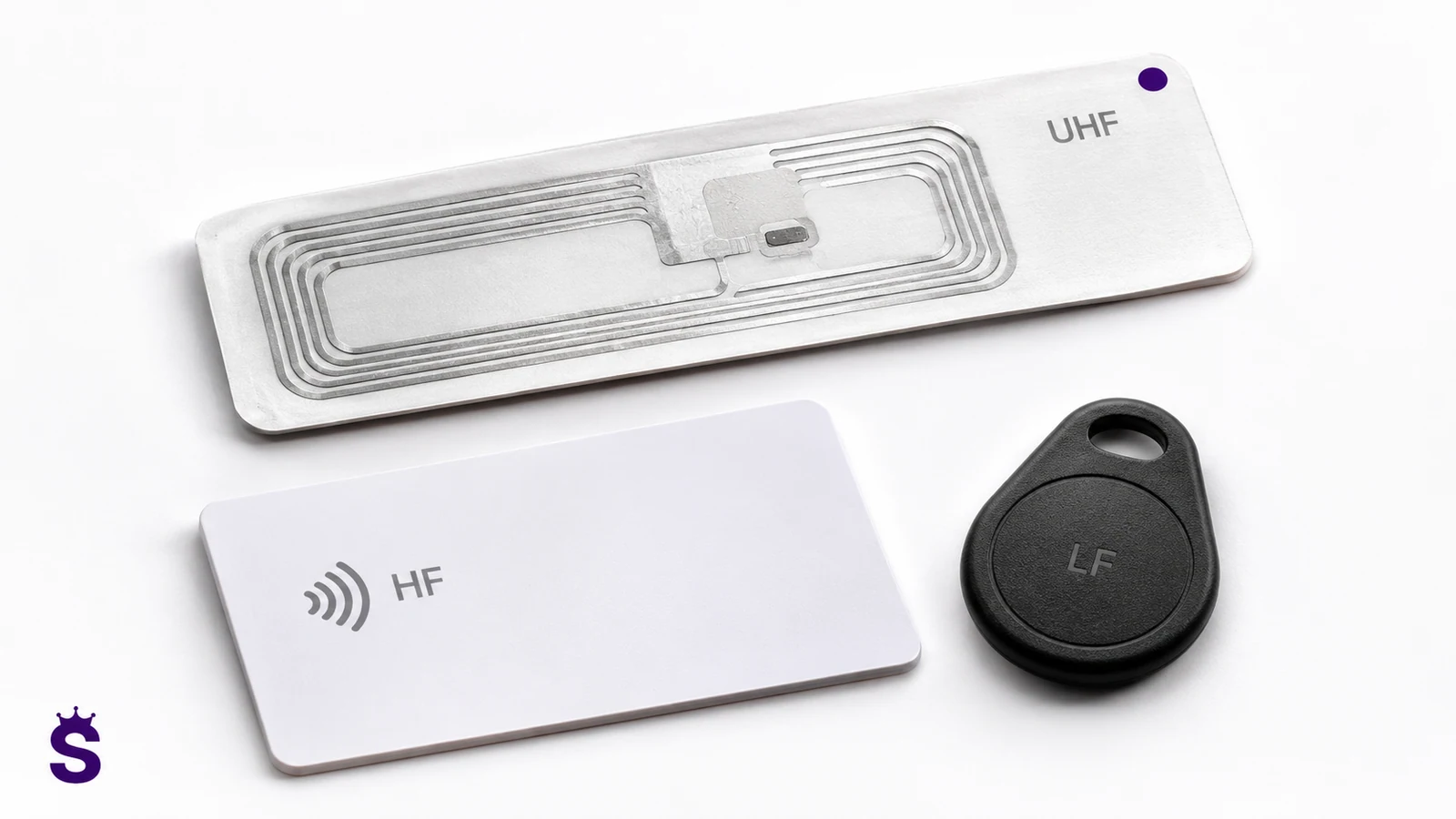
RFID standards is a set of technical standards specifying how radio frequency identification systems are to communicate - on what frequency, using what protocol and within what range. Without them, a tag purchased from one supplier would not work with a reader from another manufacturer.
tl;dr: RFID standards are divided into three main bands – LF (125 kHz), HF (13.56 MHz, NFC) and UHF (860–960 MHz, Gen2/RAIN). For textile inventory and management, UHF with the EPC Gen2 protocol is best. The Service-King system works on this standard.
What are RFID standards?
What are RFID standards in practice? These are technical agreements - they define the frequency band, data coding method, communication protocol between the reader and the tag, and reading range requirements. Without these standards, each manufacturer would create its own closed ecosystem.
Who creates the standards?
RFID standards are developed primarily by two organizations: ISO (International Organization for Standardization) and GS1 – the global body that governs product traceability in the supply chain. ISO standards define how radio frequency identification works on specific frequency ranges.
RFID frequency ranges – LF, HF and UHF
Choosing the right frequency is the most important decision when designing a system. Each band has different physical characteristics:
| Parameter | LF | HF / NFC | UHF (RAIN) |
|---|---|---|---|
| Frequency | 125 kHz | 13.56MHz | 860–960MHz |
| Range | up to 10 cm | up to 1 m | up to 10+ m |
| ISO standard | 11784/11785 | 14443, 15693 | 18000-63 |
| Application | Pets, access | Payments, hotels | Logistics, WMS |
LF – Low frequency RFID
Works in band 125 kHz. These waves penetrate water and metal much better than their higher counterparts. The reading range is only a few centimeters. It is mainly used in animal identification and simple access cards.
HF and NFC – high frequency
Working on 13.56MHz. This is the NFC technology band. It is used wherever safety and short range are important: in public transport tickets, passports and payment cards.
UHF – ultra high frequency
Scope 860 to 960 MHz. The reading range is up to several meters. The key protocol is the standard EPC Gen2 (ISO 18000-63), promoted globally as RAIN RFID. This is the standard of the future for logistics and industry.
Why is EPC Gen2 / RAIN RFID standard at Service-King?
- Bulk read: Ability to scan hundreds of tags simultaneously.
- Globality: Tags and readers from different manufacturers work together.
- Speed: Perfect for warehouse and laundry inventory.
RFID vs barcodes
Where speed of records and accuracy on a large scale are important, RFID is a clearly better alternative to barcodes. RFID does not require a "line of sight" - the reader sees tags hidden inside boxes or laundry bags.
RFID applications in practice
At Service-King, we use the UHF standard to manage textiles in hotels and laundries. Each towel or bedding has a sewn-in laundry-grade tag that is resistant to ironing and chemicals. This means that inventorying an entire laundry cart takes seconds, not hours.
Choose the right standard for your company
Contact us to choose the RFID technology perfectly suited to your business processes.
Get in touch
Tell us what you need so we can prepare an initial assessment.
FAQ – frequently asked questions
Are RFID and NFC the same?
NFC is a subset of RFID HF - it operates on the same frequency of 13.56 MHz. The difference is in the range (NFC max a few cm) and functions (NFC supports two-way peer-to-peer communication).
Which RFID frequency should you choose for hotel linen management?
For textiles and laundry, we strongly recommend UHF (860–960 MHz) in the EPC Gen2 standard. UHF laundry tags withstand hundreds of washing cycles and allow mass reading at the gates.
Do I need internet for the RFID system to work?
No – just reading the tag by the reader works offline. The Internet or LAN is only needed to synchronize data with the management system (ERP, WMS, cloud platform).
Get started with RFID
RFID standards are the foundation of modern logistics. Let us help you implement them.