

Reduce, reuse, recycle: the 3Rs in asset management
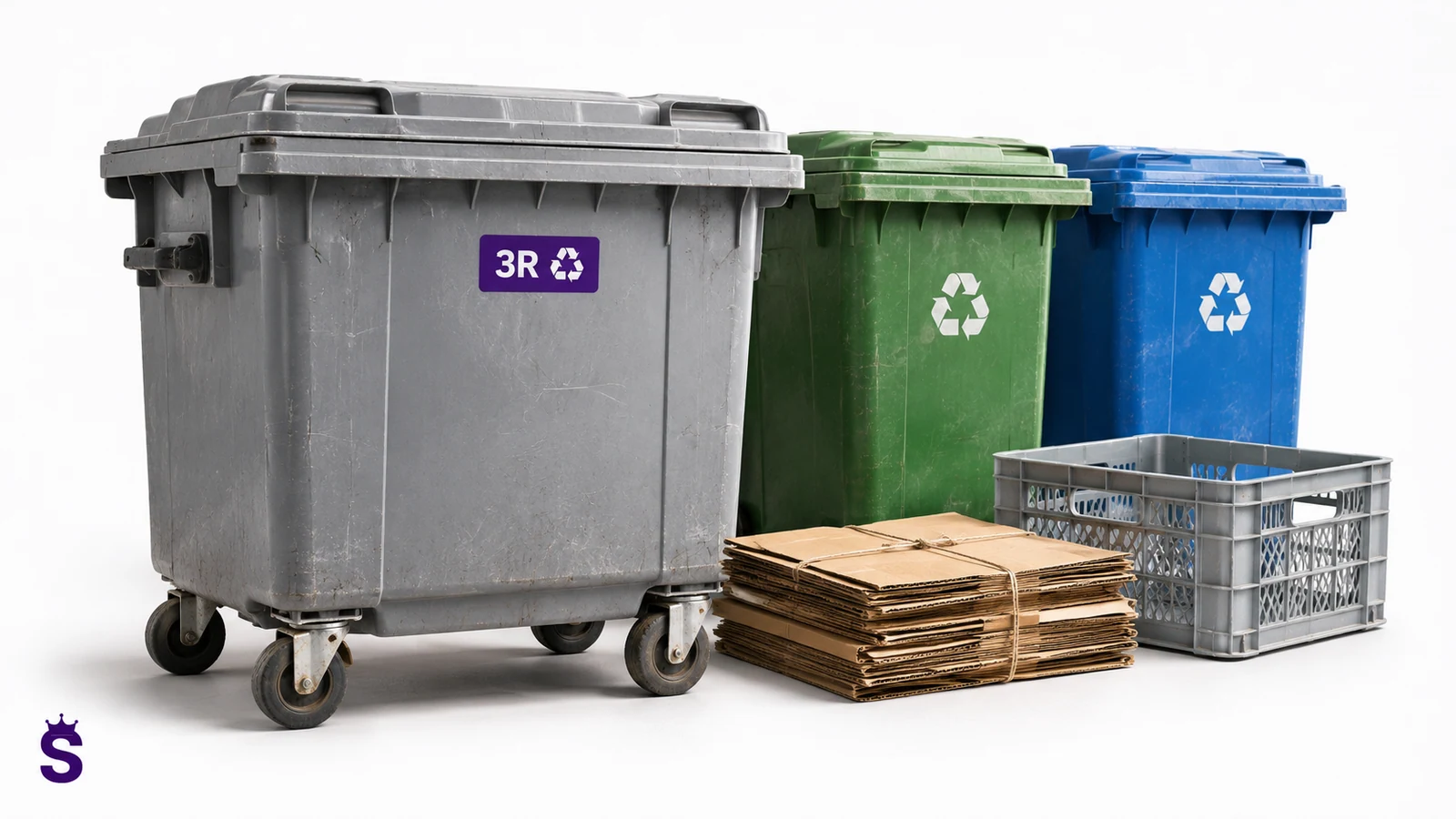
Pallets and containers designed for reuse can serve multiple trips when used and maintained appropriately. Reduce, Reuse and Recycle help organise these processes. PPWR entered into force on 11 February 2025 and generally applies from 12 August 2026. Specific targets, marking rules and exceptions have their own timelines. Not all packaging had to become reusable or use RFID from 2025.
In this article I will show what reuse really is, how the 3R principle works in practice and why reusing packaging is becoming one of the pillars of modern asset management. I will also devote a lot of space to how technology - specifically the RFID system from Service-King - allows these assumptions to be implemented without chaos and manual counting.
The 3 Rs – what does it mean?
The 3R principle is three English words that form a simple but strong hierarchy of waste management: reduce, reuse, recycle. The order is not accidental. This is not a loose list of three equivalent options, but an ordered path from the best to the least desirable solution.
1. Reduce
It's at the very top reduce, i.e. limiting. The best waste is the one that was never created at all. Before we start wondering what to do with packaging after use, it is worth asking whether we need to produce it at all - and whether it is possible to deliver the same product using less material.
2. Reuse
Only when the restriction is not possible does it enter reuse - Reusing the same item in its original function. A bottle that gets washed and refilled. A pallet that returns to the supplier. A container that circulates in a closed loop between the producer and the recipient.
3. Recycle
It's finally here recycle, i.e. recycling - processing used material into raw material for the production of new one. This is a valuable process, but also the most energy-intensive of the three, because it requires disassembling an object and building something from scratch.
This hierarchy - reduce, reuse, recycle - is the foundation of thinking about the circular economy. And although it sounds like a textbook slogan, it has a very specific impact on costs, carbon footprint and legal compliance.
Why now? PPWR context
Until recently, caring for the natural environment in the area of packaging was largely a matter of good will and image. This has changed. The Packaging and Packaging Waste Regulation (PPWR) imposes tough targets on companies across the European Union to reduce packaging waste and introduce reuse systems.
In practice, this means that companies must report how much packaging they put into circulation, what percentage of it is suitable for reuse and what their actual life cycle looks like. A disposable container or a pallet used once and thrown away is no longer a neutral cost - it becomes a burden that must be demonstrated and accounted for.
Challenge: How do we even count reuse?
How do we know that a particular pallet was circulated fifteen times and not three? Without reliable data, the whole idea of reuse remains a declaration that cannot be proven or optimized.
3R in practice - from theory to warehouse
Let's start with a distinction that often gets blurred in everyday language. Recycling is not the same as reusing. Recycling breaks down an item to recover the raw material. Reuse keeps the item intact and allows it to continue working. From an environmental perspective, the difference is enormous - reuse does not require energy for processing, transportation to a processing plant or production from scratch.
In the B2B world, reuse most often concerns the so-called RTI - Returnable Transport Items, i.e. returnable transport load carriers. We are talking about pallets, boxes, containers and a whole range of reusable packaging, which go through dozens or hundreds of cycles instead of one cycle.
Let's imagine a closed loop between the producer and its recipient. The goods are shipped in plastic containers. After unloading, empty containers return to the sender, are checked, cleaned if necessary, and continue on their next route. Each such lap is one less package that had to be made from plastic. With a scale of several thousand cycles per year, the savings - both material and financial - become very real.
It works similarly with accumulators and batteries in internal logistics. Instead of replacing cells, charging stations and systems are being built in which the same asset supports multiple devices throughout their entire life cycle. This is also a reuse - just applied to a completely different category of equipment.
Reuse rules worth knowing
For reuse to actually work and not just be a fancy name, it must be based on a few simple rules:
- Construction durability: The item must be designed to be cycled repeatedly - durable, easy to clean and repair. A disposable bottle will never be a good return load carrier, even if it is best to wash it.
- Return infrastructure: The best reusable container is useless if there is no way to put it back into circulation once it reaches its destination. Reverse logistics can be more difficult than shipping logistics and it is most often what determines the success of the entire system.
- Visibility and identification (the point): To consciously manage reuse, you need to know where each load carrier is at any given moment, how many times it has been circulated and when it requires servicing. Without this knowledge, reuse turns into guesswork.
3R in everyday life - for comparison
Before I move on to corporate solutions, it is worth going down for a moment to the level that everyone knows. The 3R rule in everyday life is nothing exotic. Reduce means giving up disposable plastic bags and consciously asking whether I really need to buy something. Reuse means filling the same water bottle instead of buying a new one, giving away clothes and trinkets instead of throwing them away, using the library instead of buying a book that I will read once. Recycling means separating and sending raw materials for processing.
Even a jam jar, which gets a new function as a container for small items, is a tiny example of the same philosophy that, on an industrial scale, determines millions of tons of waste. Same logic, just different scale. And this is a good inspiration: if in the kitchen we intuitively apply the reduce-reuse-recycle hierarchy, the company is about the same thing, only supported by data and technology.
The difference is that at home, good attitudes and a little attention are enough. In a company with thousands of load carriers and reporting obligations, striving to be eco-friendly is not enough. A system is needed.
How the Service-King system supports the 3R principle
And here we come to the point. Service-King builds solutions based on RFID technology, which turn the idea of reuse into a measurable, controllable process. Instead of believing that packaging is circulating, the company is starting it know — in terms of item, in terms of the series, in terms of location.
How does automatic RTI lifecycle control work?
Each return load carrier - pallet, container, container - receives an RFID tag, i.e. a small tag that uniquely identifies it. From that moment on, each pass through the reading gate is registered automatically, without manual scanning and without copying the numbers to the sheet.
It is this knowledge that allows you to meet the requirements of PPWR. Instead of estimating, the company reports hard numbers: so-and-so packaging in multiple circulation, so-and-so average life of the carrier, so-and-so cycles per unit. Reporting is no longer a lottery and becomes a matter of generating a statement from the system.
Reliable records can help locate lost pallets and containers, plan repairs and examine avoidable empty journeys. This may support reuse and limit replacement costs. The register alone does not prove a particular CO₂ reduction. A defined calculation boundary, reliable data and an appropriate comparison are needed.
In a broader sense, it is an element of overall asset management - asset management and WMS and CMMS systems, which Service-King develops. Reusing packaging is one area, but the same identification technology extends to tools, equipment and any assets a company wants to control throughout their lifecycle.
Circular economy is not a slogan, it is a model of operation
Circular economy is sometimes treated as a buzzword from a presentation on sustainable development. Meanwhile, it is a very specific model in which the raw material does not end its life in a landfill, but circulates in a loop for as long as possible - first by reducing, then by reusing, and only finally by recycling.
However, the circular economy only works if this circulation can be seen and measured. You can't manage what you can't see. This is why asset identification technologies are no longer an addition, but are becoming a requirement for entering the circular economy seriously. RFID is a tool that combines a beautiful idea with the hard operational reality of a warehouse.
Less waste, lower consumption of primary raw materials and a real decrease in the company's carbon footprint.
Many times longer load carriers life, elimination of theft and loss, and cheaper reverse logistics.
Full compliance with the requirements of the EU PPWR regulation and stress-free reporting based on facts.
Reduce – where to start
If you run a company that circulates returnable packaging, pallets or containers, the first step is not a large transformation program. Just ask yourself: Do I know where each of my load carriers is currently and how many times it has been used? If the answer is "about" then you have room for improvement - and one that pays off quickly.
The 3R principle is not an abstraction for CSR departments. This is a practical way of dealing with waste, which, with appropriate technological support, reduces costs, organizes logistics and protects the company against upcoming requirements. Reduce limits what you produce. Reuse extends the life of what you already have. Recycle closes the loop where nothing else can be done.
Service-King helps you base this principle on data, not good intentions. Because in the circular economy, the winners are those who really see their circulation.
Implement closed-loop load carrier tracking with Service-King
Contact us and learn how to automatically track pallets, containers and reusable packaging.
Get in touch
Tell us what you need so we can prepare an initial assessment.
Optimise returnable load carrier tracking
Stop wasting pallets and containers. Meet PPWR requirements and gain 100% transparency thanks to RFID technology.