

Knowledge base · Service-King
Lean in the warehouse: time waste, 5S and effect measures
A new scanner will not help if the operator returns for permission three times for the same operation. It is worth starting improvement by observing work and removing activities that do not improve the result.
Find where time is being lost
Walk through a typical route with the operator and record searching, waiting, rewriting and corrections. Don't just judge the scan itself. The most time-consuming task may be finding things or explaining which item to choose on a list.
| Observation | What to check before automation |
|---|---|
| Long search | Permanent places, legibility of tags and current location. |
| Number transcribing | Identifiers and the ability to transfer data without re-entering. |
| Repeated adjustments | The moment of error and responsibility for recording. |
| Waiting for a decision | Permissions, overrides, and clear exception handling rules. |
Observe movement, waiting and rework time
The number of check-outs alone does not show the effort needed to find items or decide on exceptions. Separate task time, walking and waiting during observation. Record return visits and questions to other staff. The main bottleneck may be outside the software screen.
It's worth watching the same operation in different shifts. The difference does not necessarily mean better work by one person; may be due to missing data, different postponement or dependence on the manager. The purpose of the analysis is to remove obstacles, not to judge the pace of individual operators without context.
Someone must be responsible for workstation organisation
Marking shelves helps to get things back in their proper places. Establish policies for returns, unmarked items, and repairable equipment. The temporary zone should have a clear purpose and clearing method. Otherwise it will quickly become a second, informal warehouse.
In the tool crib, separate operational, issued, unsettled and waiting for service. An employee should not have to guess whether an item at the counter is available. The Places and Statuses model can be combined with organization of zones, but the meaning of the provisions must be agreed by the team.
5S should support day-to-day work
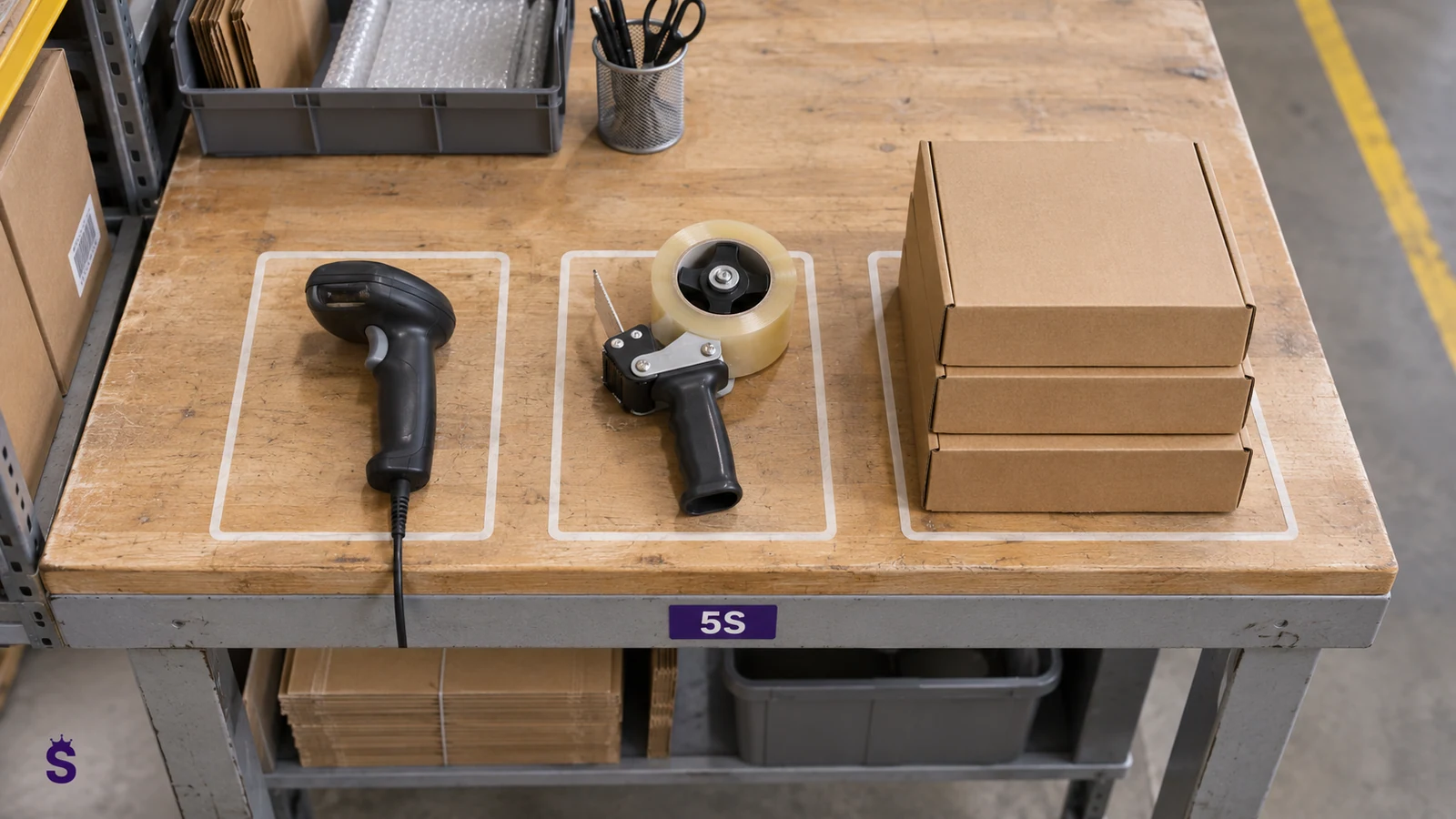
Organizing the workstation includes selecting necessary items, their places, maintaining working conditions and a repeatable standard. An aesthetic shelf label is not enough if no one puts the right items there. Establish simple control and accountability.
At the tool crib, start with the frequently released group. Remove unclear names, separate functional ones from those requiring service, and only then shorten the identification with a code or UHF.
Use the system without adding unnecessary steps
Records should capture data from the actual operation instead of requiring several parallel entries. In Service-King, the record, check-out and history may refer to the same item. The process must still indicate who confirms the actual transfer.
Too many mandatory fields lead to random entries. Too little data makes it difficult to explain differences. Test the minimum scope needed for the next decision.
Check whether the standard holds across shifts
Once streamlined, ask another operator to do the same job. If he still needs verbal explanations, some knowledge has remained outside the process. Verify names, order, and missing handling. Then return to the station after a few weeks. Maintained order and fewer corrections are better evidence of the effect than a photo of freshly labeled shelves. The system should support the standard and not require remembering additional unwritten rules.
Related topic: digital operation record.
Automate, simplify or remove?
| Decision | Example | Condition |
|---|---|---|
| Delete | Two identical entries to independent lists. | Agreed single source of data. |
| Simplify | Too many unnecessary fields to check out. | Maintenance of information required for further workflow. |
| Automate | Transfer identifiers from reading. | Valid tags and operation rule. |
| Leave control | Condition assessment after return. | Defined criteria and responsibilities. |
Speeding up an unnecessary activity perpetuates the problem. Before purchasing devices, it is worth checking whether a given step should occur at all.
The standard should help people handle exceptions
The statement should not describe only the correct case. The user needs to know what to do when a piece is missing, the code doesn't work, or there's a different model on the shelf. Clear explanation path reduces workarounds. It should be short enough so that the operator does not return to the card or private message.
Test the standard with someone who did not design the change. If he can complete the task and recognize the moment that requires a decision, the process is more resistant to staffing changes. Examples of such workflows can be found in tool crib.
How to measure whether an improvement is sustained
Compare same operation types and similar workload. Record the time, corrections, and number of clarifications, and then come back to measure after a few weeks. A once tidied shelf does not confirm a lasting change.
Discuss the results with the operator. The deterioration may be due to an increase in the number of exceptions or new product range. The report should help find the cause, rather than reducing the assessment to one average time. They are useful for this purpose listings by period and scope.
Scenario: an operator repeatedly returns to ask for a decision
During one issue, an employee asks about a replacement, then about an unreadable code and then about a missing accessory. Each answer takes a moment, but together they form a queue. The problem may not be a lack of automation, but an undefined rule. Write down recurring questions and see which decisions can be described earlier.
It's not about giving every responsibility to the operator. Some matters require the approval of the appropriate person. However, it is possible to clearly distinguish independent cases from those requiring consent and indicate a substitute. Thanks to this, work does not stop just because one person is off-site.
Prepare a simple path for three common exceptions and test it without hints. Measure the number of interruptions, waiting times and reworks. If, after a change, the operator enters random data, the standard needs to be refined. Reducing the time cannot be at the expense of concealing a shortage or incorrect issuance.
Return to results after a few weeks. A new range or different cast may reveal further limitations. The standard should have an owner and a way to update it. Instead of creating another long instruction, you can add a specific case and standardize the meaning of the message in the system. Such small changes often create a lasting effect in everyday workflow.
| Area | Practical arrangement |
|---|---|
| Questions | Repeatable situations stopping the operation. |
| Decisions | Independent scope and requiring consent. |
| Substitute | Person available in the absence of a manager. |
| Data | Information needed for clarification. |
| Measurement | Breaks, waiting and corrections. |
| Maintenance | Owner and standard update. |
Small improvement checklist
- One process and one group of things.
- Measurement before change under typical conditions.
- Removed unnecessary transitions and double writes.
- Simple exception handling standard.
- Measurement after change and control of maintaining the effect.
They will help audit checklist and tool crib example.
Questions worth clarifying before implementation
Does lean require RFID?
No. RFID can support identification, but organizing places, data and responsibilities also makes sense with codes or simpler records.
Where to start 5S?
From the chosen position and the real problem. Determine the things needed, the places, the standard of putting away and the maintenance control. Just refreshing the labels is not enough.
Do you have to measure each person?
The goal is to evaluate the process. It is usually more important to compare conditions and causes of time loss than to rank operators without context.
Go to solutions related to this topic
- Warehouse management (WMS) - Receipts, storage locations and issues.
- Map of locations and facilities - Structure of zones, shelves and saved places.
- Tool cribs in practice — Preparing equipment, issuing it to the employee and settling the return.
- Reports and movement history - Statements and documents related to operations.
Free consultation
Let's find unnecessary steps in everyday work.
Identify one operation that takes too long. We will compare the organization of places, data and the method of confirming activities.
Thank you for your inquiry.
Your message has been sent to the correct department. We will contact you to determine next steps.
Send another inquiry