

RFID in industrial laundries: textile identification
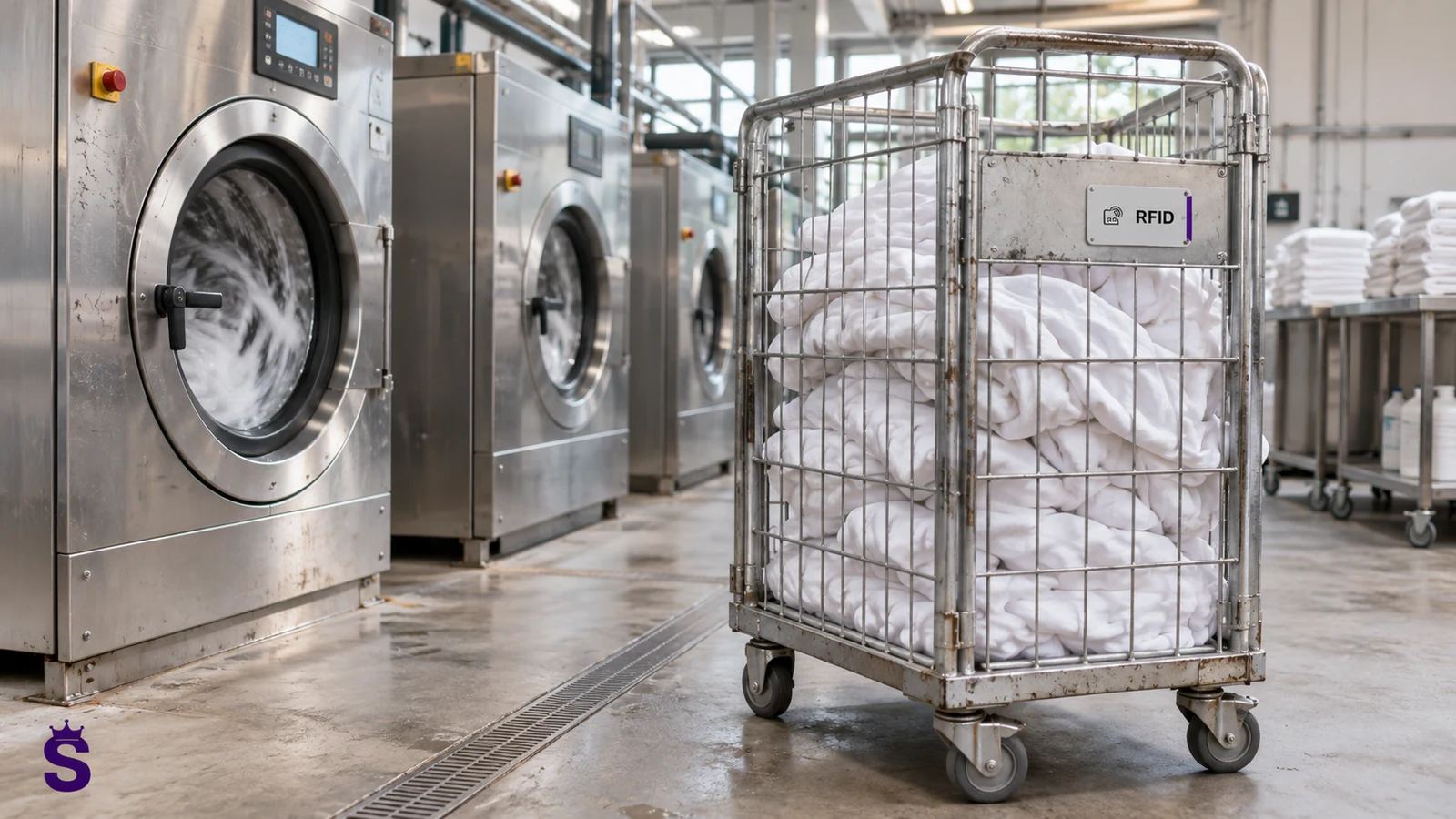
Every industrial, hotel or hospital laundry faces the same problem every day: missing towels, unpaid bedding, missing staff uniforms. Manual textile management is time-consuming, error-prone and generates real financial losses. Solution RFID for laundry changes the rules of the game - it allows you to track each piece of textiles in real time, automate settlements and regain full control over the plant's assets.
Laundry losses in hotels – a scale of the problem that cannot be ignored
Laundry losses in hotels can amount to up to 30% of the annual budget for the purchase of textiles. Laundry in hotels can amount to tens of thousands of zlotys a year just for missing towels, bed linen and bathrobes. Facilities lose thousands of zlotys before the problem is even identified.
Where do these losses come from? The reasons are prosaic:
- the guest takes a towel or bathrobe as a "souvenir",
- textiles go into the garbage bag and are disposed of,
- bedding or sheets are mixed with the laundry of other customers of an external laundry service,
- lack of inventory control means that no one knows how many items of clothing are actually in circulation.
Manual counting and inventory control are ineffective methods - a person who has to count hundreds of towels and sheets makes mistakes and wastes time that could be spent on other tasks.
How does RFID technology work in industrial laundries?
RFID (Radio Frequency Identification) technology enables the identification of objects using radio waves. RFID technology uses a tiny chip embedded in an RFID tag that can be ironed or sewn onto fabric. The tag stores a unique identification number for each piece of textile and communicates with RFID readers without the need for eye contact or manual scanning.
Key elements of the RFID system for laundry rooms
| Item | Description | Application |
|---|---|---|
| RFID tag (tag) | Chip + antenna in a waterproof housing | Ironed on or sewn onto textiles |
| Stationary readers | Gates or tunnels at entry/exit | Automatic counting on every flow |
| Mobile readers | Portable scanners for staff | Inventory in rooms or warehouse |
| Software | Database management system | Reporting, analytics, settlements |
| RFID UHF | Long Range Standard | Scanning multiple items at once |
UHF (Ultra High Frequency) RFID technology allows you to quickly scan even several hundred pieces of textiles at the same time - without unpacking laundry bags. This is a key advantage over traditional barcodes, which require individual, manual scanning of each item.
Effective textile management – what are the benefits of implementing an RFID system?
The implementation of RFID technology in industrial laundries brings specific, measurable benefits. RFID technology helps not only track textiles, but also optimize the entire washing process - from collecting dirty clothes, through washing, drying and ironing, to issuing clean textiles.
Track each piece of textile throughout its entire lifecycle
A modern RFID system allows you to monitor each item from the moment of purchase to disposal. The software records the number of washing cycles assigned to a given tag - typical laundry tags withstand over 200 washing, drying and ironing cycles. When a particular piece approaches its durability limit, the system automatically generates an alert that it needs to be replaced.
Eliminate losses and improve inventory control
RFID enables immediate detection of missing or missing textiles. If a towel or bathrobe leaves the facility without being registered, the system generates an alert. RFID technology also makes it possible to distinguish whether a given piece of bedding is in the rooms, in warehouses, in the laundry or with an external service provider.
RFID for hotel laundry rooms – benefits for guests and management
In the hotel industry, clean and accessible textiles directly affect guest comfort. Efficient inventory management thanks to RFID technology means that housekeeping always knows how many clean textiles are available and where they are.
QUALITY CONTROL
The software tracks the number of washes of each item - you know when the sheet needs to be replaced.
SETTLEMENTS WITH LAUNDRY
No more textile invoices that were never received. Full returns audit.
RFID technology in hospitals and medical facilities
Textile management in a sanatorium or hospital is even more important. Missing uniform or bedding may disrupt the functioning of the department. The washing of each item must be documented due to hygiene requirements.
| Needed | RFID solution |
|---|---|
| Uniform tracking | Each uniform assigned to an employee, visible in the system |
| Hygiene control | Registration of the number of washes, cleanliness certificate for each item |
| Inventory management | Automatic refill signals |
RFID system – Comparison of working methods
Manual management
- ❌ Inventory: several hours
- ❌ Accuracy: human dependent
- ❌ Loss control: after-the-fact response
- ❌ No lifecycle history
RFID System (Service-King)
- ✅ Inventory: a few minutes
- ✅ Accuracy: close to 100%
- ✅ Real-time prevention
- ✅ Full history of each item
Implementation of an RFID system – where to start?
The implementation of the RFID system for the laundry takes place in stages. The first step is tagging existing assets - each piece of bedding, towel, bathrobe or uniform receives an RFID tag. Then, stationary RFID readers are installed at the receipt and check-out points, as well as mobile data handheld terminals.
Managing a laundry without an RFID system is, in today's reality, blind management. RFID technology enables full control over each piece of textiles - from purchase, through hundreds of washing cycles, to disposal.