

Knowledge base · Service-King
RFID in furniture production: element, set and work stage
Furniture item, package and transport cart are different levels of identification. Before installing the readers, determine what you want to confirm at the station and how the connections change during production.
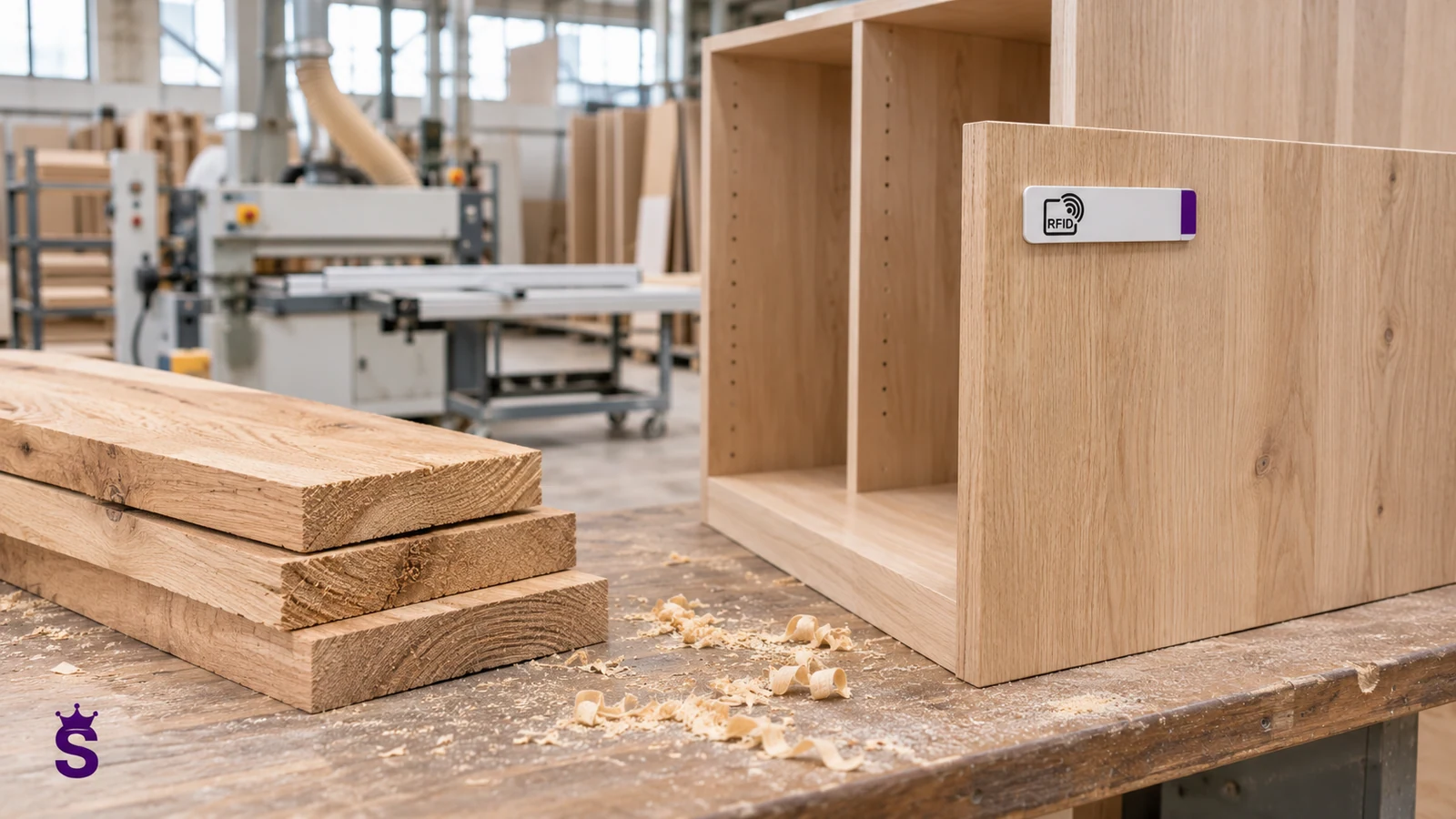
Choose the level of tracking
| Object | Meaning of reading |
|---|---|
| Item | Recognition of a specific part if individually marked. |
| Package | Identification of the agreed entity containing the items. |
| Cart/carrier | Recognition of load carriers and saved relationship with content. |
| Tool/Jig | Record of station equipment. |
A tag on a cart does not prove that all previously assigned items are still on the cart. After batch separation, the system must receive the correct information.
Parts and load carriers need different tracking relationships
If an item is marked, the reading is for that item. If a cart is tagged, the system only knows the maintained association with the content. Partial discharge must change the data if the next read is to have the correct meaning.
Plan division, merging and repacking before the project. Determine when a new entity is created and what happens to previous identifiers. Without this logic, even correct reading may show outdated content, and the user will not know where the difference comes from.
The tag must survive the relevant process stage as well as transport
Cutting, gluing, pressure and surface finish affect the possibility of installation. The marker should not enter the processing area or deteriorate the quality of the product. The test must be carried out through the planned part of the process on a finished object.
If tagging the carrier is safer, be clear about the information it provides. Do not present a trolley’s history as the complete individual history of all its parts without supporting records. Choose the tag and placement after assessing the process.
The process may damage an unsuitable tag
Cutting, taping, pressure, temperature and surface finish may alter the suitability of the installation site. The marker should not enter the processing area or impair the quality of the product. The test is performed throughout the planned stage of the process.
With a fixed reading point, you need to control neighboring batches and the interpretation of the event. The mere detection of an element does not mean that the technological operation was performed correctly.
Where Service-King helps
The practical scope is the records of tools, devices, machines and carriers. Records and history help recreate the workflow of equipment. Full production accounting, routes and integration with machines require a confirmed MES or ERP scope.
Automatic traceability of an entire product should not be promised based on a single shipping tag. First, you need to describe the division and merging of units.
Example: a trolley is partially unloaded
The operator takes some of the elements to the station, and the rest move on. If the system only knows the cart ID and the old list, the next reading may suggest the presence of the entire package. You need an event that changes the content or some other way of individual confirmation. In the test, it is worth undergoing such a division, and not just a complete test run without any changes. This shows whether the identification supports the actual organization of production.
Related topic: monitoring work stages.
Different objectives require different confirmations
| Target | Object | Data condition |
|---|---|---|
| Recognize part | Individually marked item. | Correct stage binding and persistence. |
| Move package | Agreed unit. | Current content list. |
| Clear the cart | Return load carriers. | Load carriers check-out and return. |
| Confirm the operation | Correct step in the process. | Execution rule and result. |
| Record position | Tools and instruments. | Items, state and history. |
Reading is not automatically a quality check
The detection of an ID at a point does not prove that the machining was performed as required. You need the right signal or confirmation and, when assessing quality, the right procedure. Distinguish presence, completion of the operation and its result.
In the project, determine which event enters the system and what it should change. When repeating the pass, another operation performed should not be accidentally counted. Warehouse and production dependencies require consistent identifiers and integration rules.
How to start with a useful scope for Service-King
Practical areas may be station equipment, load carriers, parts and recording of agreed steps. The scope of full MES, routes and control must be confirmed separately. Reference points constitute process monitoring and industry and production.
Select one fragment and check the correct course, batch division and missing data. Assess whether the next person understands the result without asking the previous operator. This is a more useful criterion than just the number of tags read.
Scenario: a trolley is unloaded at two workstations
The first operator takes some of the elements, and the rest move on. If the system only knows the former contents of the cart, the next reading may suggest the presence of the entire package. Load carriers relationship needs to be updated when content changes. The radio signal itself will not recognize what untagged items have been previously taken.
Decide whether to identify each part, a bundle or only the movement of a carrier. Each level provides different information and recording costs. A trolley tag alone does not establish an individual product history. If group-level tracking is sufficient, name it clearly and define how groups are split.
When confirming a process stage, distinguish an item's presence from completion of the operation and its result. A trolley can pass a workstation without processing. A second appearance should not count as another completed operation without a suitable rule. Define the expected business outcome before configuring the reader.
Include item missing, load carriers change, and incorrect association in the sample. The operator should have a simple correction path with an appropriate scope of authorizations. If each deviation requires adding a private note, the data will no longer reflect the process despite correct readings.
Once launched, check to see if the next person can recreate what went into the station and what was left behind. The measure is the readability and completeness of the flow, not just the number of tags in the session. MES or ERP integrations and quality control requirements remain a separate, confirmed scope of the project.
| Area | Practical arrangement |
|---|---|
| Level | Retail, package or load carriers only. |
| Division | Content update after check-out. |
| Stage | Distinguishing attendance from performance. |
| Repetition | No unintentional accrual. |
| Correction | Clear path and permissions. |
| History | Range recoverable by another station. |
Pilot checklist
- Clearly identified identification object.
- Mounting location outside machining area.
- Rules for changing package or load carriers content.
- Attempted to read at typical density.
- Confirmation of data transferred to other systems.
See warehouse and production integration and machinery records.
Questions worth clarifying before implementation
Is it enough to mark the stroller?
May be sufficient for load carriers records. Correct relations and change operations are needed to control the current content.
Does RFID replace MES?
Is a way of identification. The scope of production management and accounting depends on the systems and project, not on the tag itself.
How to check the suitability of a marking?
On an actual item or load carriers, through the appropriate process step, including machining and final placement.
Go to solutions related to this topic
- Process monitoring — Equipment, parts and recorded stages on the shop floor.
- Industry and manufacturing - Machines, tools and parts in common workflow.
- Warehouse management (WMS) - Receipts, storage locations and issues.
- Digital image of the company - Combining things, places, people, and operations.
Free consultation
Let's define what a workstation read should confirm.
Describe items, packages and load carriers, and content changes in the process. We will select the level of identification and the scope of data.
Thank you for your inquiry.
Your message has been sent to the correct department. We will contact you to determine next steps.
Send another inquiry