

RFID garment tagging: tags, fitting and read tests
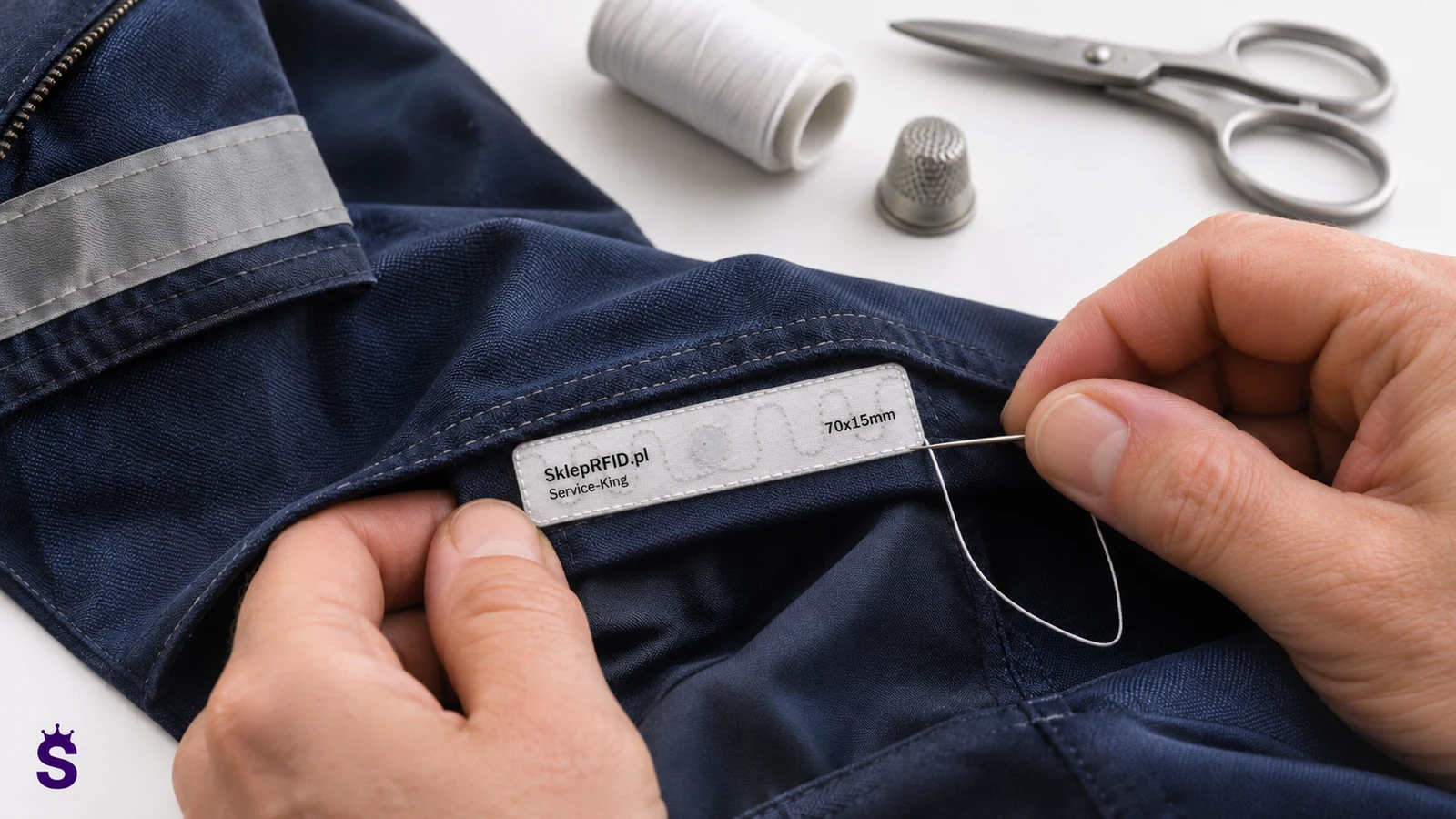
Managing work clothes, hotel towels and hospital underwear is a daily challenge for hundreds of companies in Poland. Lost laundry, errors in settlements with the laundry, lack of knowledge about how many washing cycles a given piece of clothing has undergone - these are problems that cost time and money. RFID clothing tagging solves them once and for all.
What is RFID technology and why is it used to mark clothes?
RFID (Radio Frequency Identification) is a method of wireless data exchange between a tag and a reader. Each RFID tag contains a unique identifier that the reader reads without the need for direct contact or even visual access to the tagged item. In the context of clothing marking, this means that the RFID reader is able to inventory dozens or hundreds of pieces of clothing at the same time in a few seconds - without manually counting and scanning each item individually.
UHF (Ultra High Frequency) radio identification technology allows tags to be read from a distance of up to several meters, which makes it particularly useful in warehouses, laundries and large hotel facilities. That's why UHF RFID has become the de facto standard in the laundry and clothing industry, slowly replacing traditional barcodes that require a direct line of sight between the reader and the label.
Marking laundry clothes using RFID technology is used wherever the flow of clothes is intense and identification errors generate real losses. Hospitals, hotels, production plants, washing clothes, occupational health and safety - these are the areas where the RFID system brings the greatest savings.
RFID laundry tags – what is it and how do they work?
RFID laundry tags are special tags designed to work in extreme conditions of the washing process: high temperatures, moisture, chemicals and mechanical stresses during ironing and ironing. A regular RFID tag would destroy itself after a few washing cycles - UHF RFID laundry tags can withstand over 300 full cleaning cycles while maintaining full functionality.
Laundry tags can be sewn directly into the seams of clothing, ironed into the fabric or attached in another permanent way - so that they do not affect the comfort of use or the appearance of the marked clothing. RFID laundry tags are manufactured in accordance with OEKO-TEX Standard 100, which means they do not contain harmful chemicals and are safe for the skin.
The leader in the laundry tag market is Datamars, whose RFID tags are considered one of the most durable solutions available. Datamars RFID laundry tags are suitable for both occupational health and safety work clothes and delicate hotel linen: towels, bathrobes, bed linen and pillowcases.
What makes good laundry tags?
- Resistant to laundry conditions – high temperature, detergents, ironing, ironing, drying.
- Mechanical strength – resistance to mechanical damage during intensive use.
- Certification – OEKO-TEX standard and compliance with the RoHS and REACH directives.
- Read range – a good UHF RFID tag allows reading from a distance of more than several meters.
Where is RFID clothing tagging used? Industries and applications
Hotels: tracking towels, bed linen and bathrobes
In the hotel industry, marking clothing with RFID tags solves one of the most costly problems - disappearing textiles. Each towel, bathrobe or bedding set receives an individual RFID tag that allows it to be tracked.
Service-King dedicated solutions hotel and laundry industry allow you to integrate RFID clothing marking with a comprehensive facility asset management system. Thanks to this, the hotel has full control over the flow of clothing and textiles - it knows what is in the laundry room, what is in the rooms, and what may have been lost.
Hospitals and medical facilities: staff clothing and hygiene
In hospitals, RFID clothing marking serves not only to control costs, but also for sanitary safety. The RFID system allows you to monitor the washing cycle of medical clothing. When the number of washing cycles exceeds the permissible limit, the system automatically signals the need for replacement.
Manufacturing plants: workwear and protective clothing
Marking work clothes with RFID tags is the answer to the challenge of managing hundreds or thousands of pieces of occupational health and safety clothing assigned to specific employees. It is also possible to automatically detect unauthorized attempts to take clothes outside the plant - using RFID gates installed at the exits.
Laundries: process automation and customer reconciliation
An industrial laundry can be managed much more efficiently thanks to the RFID system. Laundry management software generates reports on the number of washing cycles for each piece of clothing, inventory levels, on-time deliveries and customer settlements.
What does an RFID system for marking clothes look like? Components and infrastructure
A complete RFID clothing tagging system consists of several key elements:
Laundry Tags
Specialized UHF RFID tags (e.g. Datamars) resistant to dry cleaning and temperature.
Readers and Gateways
Mobile devices (Chainway) or stationary gateways for mass reading of clothing.
S-King WMS
The brain of the system collecting data and generating reports on laundry circulation and history.
RFID and barcode – why does RFID clothing marking win?
Traditional barcode labeling of clothing has been the standard for years. However, barcodes have fundamental limitations: they require a direct line of sight, only one label can be read at a time, and the labels deteriorate quickly.
RFID technology eliminates these problems. The RFID reader reads hundreds of tags simultaneously, without the need to aim at each one individually - all you need is for the clothing to be within the reader's range. In the context of labeling laundry clothes, where every minute and every piece counts, the advantage of RFID over a barcode is clear.
Frequently asked questions
How many washing cycles does an RFID laundry tag withstand?
Professional UHF RFID laundry tags are designed for over 300 full laundry cycles (washing, drying, ironing, ironing).
Are RFID tags safe for skin?
Yes. Laundry tags are certified according to OEKO-TEX Standard 100 class 1. They do not contain harmful substances and are safe in contact with the skin.
Can the RFID system be integrated with ERP?
Yes. Our Service-King software allows integration with popular ERP and WMS systems, which allows for automatic data flow.
Summary – RFID clothing marking as an investment in efficiency
RFID clothing marking is not only a modern technology - it also saves time and money. RFID UHF laundry tags allow for full identification of each piece of clothing throughout its entire life cycle. The RFID system eliminates manual inventory errors, prevents theft and loss, automates settlements with the laundry and provides data necessary for assortment management.
Ready for an RFID system in your company?
We will help you choose the optimal tags, readers and software.
Get in touch
Tell us what you need so we can prepare an initial assessment.