

Digital product passports: DPP requirements and RFID
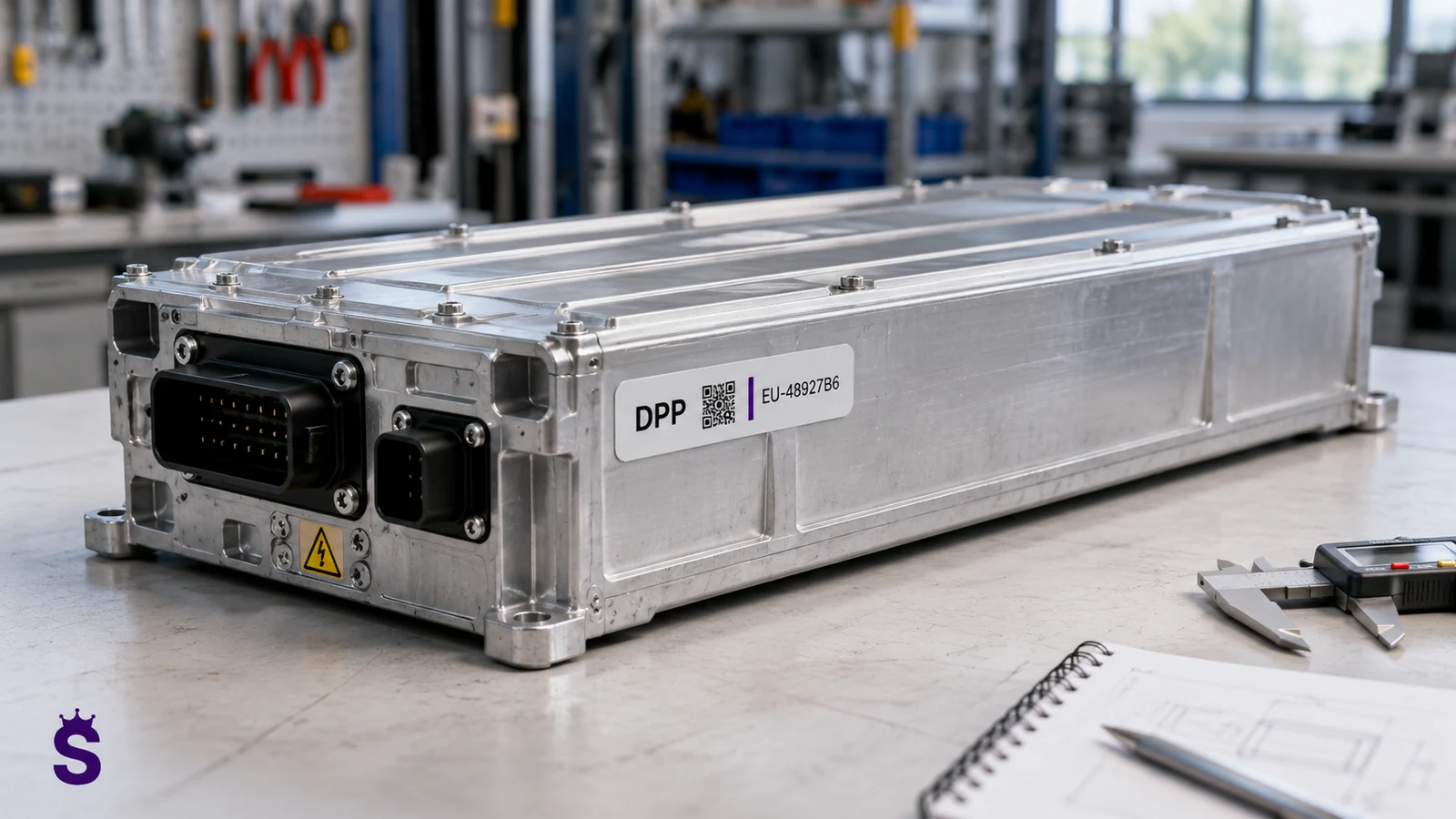
The EU is developing infrastructure for product information. The digital product passport is being introduced in stages for specific product groups. Not every product needs a digital passport from the same date. Applicable legislation determines the data, access rights and deadlines. This article explains DPP and how Service-King can help organise identifiers and recorded history.
What is a digital product passport?
A product passport provides a structured digital set of product data. The term digital product passport is abbreviated to DPP. A data carrier, such as a QR code or another suitable barcode, links the product to that information. Product-specific rules determine the required data, carrier placement and access. Information may cover composition, origin, repair, recycled materials and end-of-use treatment.
The goal is clear: passport is intended to increase transparency throughout supply chain and support the circular economy. Instead of scattered labels and catalog cards, one, coherent one is created registry data that accompanies the product by entire life cycle - from production, through use, to recycling. Everyone business entity in the value chain uses the same, verified information.
It is worth clearing up a common misunderstanding right away: DPP is not yet universally mandatory for all goods. ESPR Regulation creates a legal framework, and specific requirements are introduced in stages - separately for each subsequent one product groups, through delegated acts i implementing acts adopted by European Commission. This distinction is crucial for any company planning DPP implementation.
Legal basis: ESPR Regulation and implementing acts
The foundation of the entire system is ESPR regulation - Regulation European Parliament and Council (EU) 2024/1781 re ecodesign for sustainable products. It replaced the previous Ecodesign Directive and significantly expanded its scope: it covers almost everything product groups introduced on EU market, and not just energy-related devices.
As the ESPR is a regulation and not a directive, it applies directly in all Member States without the need to transpose it into national law. Detailed information - what exactly data set has include passport of a given category, which one data medium apply and from when - the Commission shall specify separately in implementing acts and delegated to individual groups. That's why DPP provisions they will introduced gradually, category by category.
They work in parallel regulation sectoral ones, which introduce the passport obligation regardless of ESPR. The most important of them is the regulation on battery (EU) 2023/1542 - it was the first to explicitly establish the obligation having a digital product passport.
Timeline: when does DPP become mandatory?
The schedule is an area where it's easy to get misinformation, so let's stick to confirmed dates.
Infrastructure has already started in 2026 July 16, 2026 the regulation was adopted implementing regulations establishing operating rules Register digital product passports, and from July 20, 2026 central registry DPP runs with the test environment. This means that 2026 is primarily the time to build infrastructure and select solutions - before the first hard obligations enter into force.
A digital passport becomes mandatory for specified batteries under Regulation 2023/1542 from 18 February 2027. Adoption of an ESPR delegated act for iron and steel was planned for the fourth quarter of 2026; this is not automatically the date its requirements apply. Requirements for further groups, including textiles, are developed separately. Check official acts and European Commission updates: planning, transition periods and application dates are distinct. DPP does not apply to all products at once.
Which products will require a digital product passport?
Ultimately digital passports will cover almost all of them product groups introduced on EU market - with a few exceptions, such as food and medicines. In practice, however, the obligation does not appear for the entire market at once, but category by category, as subsequent acts are adopted European Commission.
The ESPR Regulation establishes a framework for product-group requirements, with priorities such as iron, steel and textiles. Separate regulations also govern batteries and other sectors. Whether a product needs a mandatory passport, which data it must contain and from when are determined by the applicable act. Build a useful dataset and check the specific DPP rules for your goods. There is no single date for every category.
Who must provide a digital product passport, and who issues it?
The responsibility for creating and maintaining a passport rests with economic entity, which introduces first product on EU market - most often it is the manufacturer, and in the case of goods from outside the EU, the importer or authorized representative. This is the one entity is responsible for completeness and accuracy data in DPP and for associating a physical item with its record in registry.
In practice, however, the passport is created from data collected by many participants supply chain: raw material suppliers, production plants, logistics operators and entities recycling companies. Each of them brings their own piece of history product on the next ones stages of the product life cycle. However, access to the contents of the passport varies depending on the role - consumer will see a different range of information than supervisory authorities market or partners in value chain. The data provided to the consumer is intended to support him conscious choices, and those transferred to supervision to enable compliance checks. For the company, this means one thing: to as entity responsible to issue a reliable passport, you must have organized, verified data from entire life cycle of your product.
What does a digital passport contain, and what role does its identifier play?
Specific scope data in DPP varies by category, but ESPR outlines common pillars that contains information about the product on several levels:
- unique product identifier - allows you to uniquely associate a physical item with its record in the registry,
- product-specific data - composition, origin, technical parameters, environmental footprint,
- information about repair, spare parts and reusability,
- data on recycling and handling of the product as waste,
- environmental impact v throughout the life cycle.
A unique identifier links the product to the right data. GS1 Digital Link is a URI syntax based on GS1 standards, rather than a physical carrier. A QR code can identify a product and link to digital information. Other suitable carriers are possible; a conventional barcode has different capabilities. Globally unique identifiers support exchange across international supply chains. GS1 Polska supports these standards in Poland.
It is crucial to understand the difference: the Commission's register keeps first and foremost identifiers and metadata, while the actual one data set about the product comes from entity placing the goods on the market. In other words, the passport itself is only as reliable as the data behind it. And this is where the real operational challenge begins.
The biggest DPP challenge: finding reliable data
Filling out the declaration or generating it QR code is the part that's easy to imagine. The more difficult thing is the invisible one: where to get current, quantifiable data about what is happening with product v circulation - how many times he came back, where he is physically, what his history is in the next ones stages of the product life cycle.
For many companies today, this information is scattered in spreadsheets, e-mails and employees' memories. Meanwhile supervisory authorities market have the right to request documentation, and a passport has monitor product for years. This can't be reconstructed manually at the time of inspection - you need a system that collects this data automatically, on an ongoing basis, from day one.
This is exactly where Service-King comes in.
How Service-King RFID builds data for a digital product passport
Service-King is not a replacement legal advisor or complete the declaration of conformity for you. We are doing something without which these documents will not be created anyway: we give each product a digital identity and record its history throughout its life cycle. This is the foundation on which everyone relies digital passport.
We give every item a unique identifier
Each product, returnable packaging or component receives a durable data carrier - RFID UHF, QR or NFC - with a connected card. This is a ready-made infrastructure for the identification requirement, consistent with the approach GS1 Digital Link: one identifier, many uses.
We collect movement data automatically
UHF RFID technology allows you to read hundreds of units in a few seconds, without scanning piece by piece and without rewriting numbers. Every movement - check-out, return, change of location - records itself in the history of the entity. Data about chain flows, turnover and utilization are collected in the background and are immediately ready for reporting.
We keep a register ready for inspection
Cloud operation history, flow reports and full documentation in one place registry, which answers questions supervision market in a few clicks, instead of a week of reconstruction. It's the same set of data that feeds both digital passports, as well as current operational reports.
We track the product throughout the entire supply chain
You see which business partner has a given unit, how many days he has had it and at what stage life cycle is located. This visibility in value chain is also a source of passport data and real operational control over the fleet.
DPP and PPWR: how are they connected?
Data for an ESPR digital product passport (DPP) and PPWR may partly use a shared register: a unique number and recorded movements. Requirements for a product and reusable packaging differ. PPWR generally applies from 12 August 2026; reusable-packaging marking follows a later timetable and specific exceptions. A data carrier and automated records may help, but RFID and an individual automatic counter are not mandatory for all packaging. Check the applicable provisions and dates.
Service-King builds this common layer once - and you use it for both reuse reporting for PPWR and for DPP implementation for others product groups. This allows you to spread the cost of one infrastructure over two regulatory obligations and avoid building a separate project for each regulation.
Why it is worth starting now, rather than in 2027
Although the first hard deadlines concern narrow categories, the logic of preparation is common to all. 2026 is a window for peaceful implementation before regulation applies to your industry. Companies that issue identifiers and collect data about products today, the moment the obligation enters they will have it ready data set — and they will proceed to generating the passport instead of building everything from scratch under deadline pressure.
Grant unique ID and start automatic register circulation is a decision that pays off regardless of whether your category enters 2027or later. Product data collected from today is conscious choices - Yours towards regulations and the consumer towards your goods.
Summary: product lifecycles in the era of DPP and PPWR
Digital Product Passport is one of the pillars of the EU economy circularity and market building element sustainable products. DPP will be introduced gradually, but the direction is certain: more and more products sold v EU will have to be carried with you digital set product data, available via data carrier.
Winning this game does not depend on who generates the fastest QR code — but from whoever has reliable, up-to-date data behind it. Service-King gives you the foundation: unique ID on each unit and automatic registry its history by entire life cycle. The rest of the passport is based on ready-made data.
Want to check how to build pod data DPP implementation in your company? Contact Service-King - we will show you the system using your example.
Prepare your company for DPP and PPWR
Contact us and integrate your digital product flow with RFID and GS1 Digital Link.
Get in touch
Tell us what you need so we can prepare an initial assessment.
Build your products' digital identity
Ensure full compliance with EU regulations, track load carriers and products in real time.